
Quick Reviews: Three New Books
Three new, interesting books on the world's worst viceroy, history that rattles and the drone era upon us

“Shattered Lands: Five Partitions and the Making of Modern Asia,” by Sam Dalrymple (William Collins, 2025).
The Partition of 1947 that gave birth to India and Pakistan is a source of endless fascination to South Asians. To the rest of the world, not so much. But it shouldn’t be like this. The Partition is one of the most important moments in 20th century history, given that it shaped the future of a quarter of the human race, and it really is fascinating to learn the way Louis Mountbatten (1900-1979) — one of stupidest people to hold a great deal amount of power in history — made a mess of it.
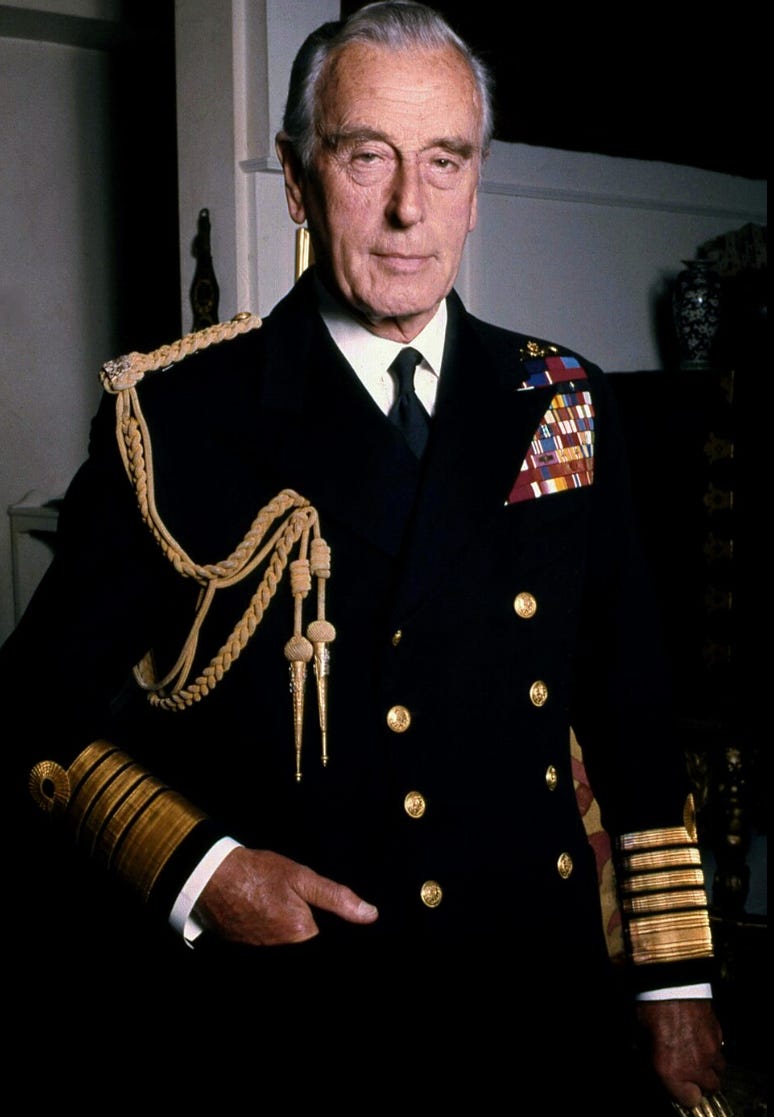
Mountbatten, whose entire biography is a repudiation of any alleged right of the English elite to rule anything or decide anything at all…

… was the last British Viceroy in India. After World War II, with the US having set off a timer for the English to disassemble their empire, this was a complicated job, and Mountbatten was the worst possible person for it. Posh, given to high-profile snafus, openly derided by his social superiors and inferiors, arrogant and supercilious, Mountbatten struggled to contain powerful forces driving Muslims and Hindus towards ethnic war.
Anybody could have avoided amazing self-goals like the one he announced in June 1947. Like Dalrymple explains in his book (p. 176), having managed to secure a preliminary deal for the Partition of British India between Pakistan and the new republic of India, Mountbatten had a few glasses of whisky and soda, and came up with a new plan:
“The next morning, feeling triumphant, he delivered a second surprise. In a short announcement to the press, he explained that the deadline for the transfer of power would be moved forward almost a year to 15 August, 1947. ‘The date I chose came out of the blue,’ Mountbatten later recalled. ‘Why? Because it was the second anniversary of Japan’s surrender.’”
That a hangover Mountbatten decided on his own that the Pakistan-India division would have to be conducted within 77 days, after years of complex negotiations and with multiple tricky issues still hanging in the balance, is a curiously huge footnote in the biography of this dangerously unserious man. However, there are multiple similar moments in the book.
Much has been written about the open marriage between Louis and his wife Edwina, who slept with one of the main protagonists of Partition, India’s Jawaharlal Nehru. More interesting than these sordid personal lives is the fact that Louis and Edwina competed over such trivial matters as who had shaken more hands of prisoners in the prisoner camps they visited (p. 137). Perhaps as part of the competition, Edwina — like her husband a hopeless snob — loved to express leftist opinions in public, to shock their fellow aristocrats, and there was no Asian nationalistic movement she didn’t like.
Louis preferred exotic pets and the care of his elevated station. On a plane to Singapore, where he was supposed to accept the Japanese surrender of the island, he discussed little else other than a problem with the lock of the lavatory door, as it wouldn’t shut properly (p. 136). Mountbatten loved his Japanese: he employed thousands of Japanese prisoners as garrison troops across Asia, and was probably delighted by the nickname they received in England: “Mountbatten’s Samurai.”
On the day of Partition, the Mountbatten couple flew from Karachi to Delhi over the Punjab, and multiple large fires were visible on the ground, as ethnic massacres were already in full swing, but Mountbatten didn’t seem to notice. In Delhi, he enjoyed a relaxed evening: he watched the new Bob Hope movie, “My Favorite Brunette,” and two minutes before midnight, when his position would vanish, he granted the title “her highness” to the Nawab of Palampur’s Australian wife. It would be his final act as viceroy (p. 201).
Compared with Mountbatten, other characters in the book emerge victorious, heroic, selfless, dedicated, no matter their human errors. Even Pakistan’s founding fathers appear rational and sensible — not the typical adjectives to describe Pakistani policymakers ever since — to the point that, as late as 1940, Tamil separatism looked likelier than the establishment of a separate Muslim “Pakistan.” (p. 62.) This is what the anglophone Muhammad Ali Jinnah, later that country’s first governor general, wrote about such a separate Pakistan then:
“Some sort of Disney dreamland, if not a Wellsian nightmare.”
My Indian readers will appreciate the comment. It does makes sense if we consider that, in the 1937 elections conducted across India, Jinnah’s Muslim League crashed down (p. 58) and didn’t win a single seat in Muslim-majority Punjab (later the Pakistani core.)
It may all have been Delhi’s fault. Not the metaphorical Indian elite: Delhi, the city, described by Aldous Huxley in the 1930s as “pullulated with despots” wearing “diamonds so large that they looked like stage gems; it was impossible to believe that the pearls in the million-pound necklaces were the genuine excrement of oysters.” (p. 34).
This kind of touch is all over Dalrymple’s book. Rabindranath Tagore, visiting Burma, is appalled by Indian dominance and thinks the natives are suffering “double colonialism” (p. 18). A degree of British distraction is understandable: the British South Indian territories were so large that at the time Britain played down their size for diplomatic reasons and maps depicting them in their entirely were only published in top secrecy. Indeed, the Viceroy’s informal protectorates over Nepal and Oman were never officially recognized as such for the same reasons (p. 19).
History That Rattles: The Strange, Sharp, and Surprising Stories School Skipped — A Darkly Funny History of Survival, by Barbora Jirincova (Self-published, 2025)
Barbora Jirincova is in Substack and sent me a review copy of her delightful little history book, now on offer for EUR0.99. My expectations weren’t super-high for this kind of short book, yes, but I still quite enjoyed it. It’s a really easy and fun read with surprisingly poignant moments:
Before 1850 and earlier, as many as half of all children died before reaching adulthood. Historian Philippe Ariès once claimed this meant parents didn’t bond with their offspring as deeply, that necessity dulled grief. This “black legend” has since been challenged. Primary sources testify that people loved their kids. But they had to live knowing they might lose them. British historian Hannah Newton uncovered letters, diaries, and marginal notes that speak of aching loss, of mothers who buried one child and gave birth to another days later. The pain was real. It just couldn’t be all-consuming. Life went on, whether or not they were ready. Children died so easily because they were born into frailty and filth. Because infection lived on hands, blankets, water jugs, and lips. Because there was no immunity, no sanitation, no concept of contagion. Because toddlers wandered near pigs, played in alleyways, and caught everything going around. And because their mothers were dying, too. Women who survived childbirth often went on to care for the sick, bury the small, and conceive again. They were nurses, undertakers, and vessels of hope, even when their bodies were exhausted.
This point she made about grief is very important, and is one that I — as the father of two children — I’ve often thought about. Would I be as sad if 50% of my children were sick or missing or whatever as if only 10% (say, one of my ten children) was? I often thought I wouldn’t, but the point is here is that I probably would be just as distraught — but I would move on much faster.
Anyway, I prefer not to dwell too much on this. An important subject, but not a favorite one with parents. Moving on, this is also eye-opening:
Leprosy peaked in Europe between 1000 and 1250. Then, suddenly, it faded from the historical record in the mid-14th century. The timing is so precise that it begs for explanation: In 1347, the Black Death arrived, and leprosy vanished. Some historians have wondered whether plague survivors developed immunity to leprosy. That theory doesn’t hold up. The more likely explanation is that leprosy didn’t disappear; it just became invisible. Donations and religious charities funded leprosaria. The pestilence collapsed those systems. With the infrastructure gone, the few people who actually had Hansen’s disease quietly rejoined society. And because it’s not especially contagious, it didn’t spread. The idea of leprosy faded; and with it, the disease itself.
This, meanwhile, is a very Central European thing to write, Barbora, you Czech girl:
Vineyard records from the late 1500s in Austrian regions paint a grim picture. Between 1580 and 1600, sugar levels in grapes dropped so low that wine became undrinkable. In some years, grapes didn’t ripen at all. Locals gave up and turned to beer.
True, but still a very Central European thing to write. I highly recommend other parts of the book but this is how far I will go with the spoilers.
“Beast in the Machine: How Robotics and AI Will Transform Warfare and the Future of Human Conflict,” by George M. Dougherty (BenBella Books, 2025).
This is a book you need to read right away, because otherwise it will become hopelessly outdated. It’s a solid overview of how drone warfare, in particular, is changing the shape of military conflicts much, much faster than most people believe. People who are not paying attention to the fronts in the Ukraine are missing out on a glimpse of a terrifying future.
To me, the greatest value in this book is historical. It provides great context on how we got here See this, for example:
The Germans, in contrast, didn’t try to make unmanned versions of existing vehicles. Instead, their robotic wunderwaffen included remote- controlled precision bombs that let individual German aircraft sink the mightiest warships. On August 27, 1943, a squadron of German bombers used the new Hs 293 winged, radio-guided, rocket-propelled bombs to destroy the British warship HMS Egret and damage the Canadian destroyer Athabaskan off the coast of France. The Allied ships never got to fire a shot before the weapons struck home. Two weeks later, the bombers attacked the Italian battle fleet as it attempted to surrender to the Allies. With heavy armor-piercing Fritz X bombs that used the same radio guidance as the Hs 293, they sank the 45,000-ton Italian flagship Roma and damaged her sister battleship Italia while remaining outside of anti-aircraft range.
Next, the Luftwaffe turned the bombers against the Allied invasion fleet off Salerno, where they did so much damage that the invasion of Italy was almost stymied. Soon after, a hit from an Hs 293 sank the British troop ship Rohna in the Mediterranean, loaded with thousands of US soldiers, killing 1,149 soldiers and crew and resulting in what remains the greatest- ever loss of American life at sea due to enemy action, a disaster that remained secret until the 1960s. The Allies’ saving grace was that the Germans only had a few of these weapons, and only two specialized bomber units could use them.
I think I may have to write a piece on how Nazi Germany had all this amazing technology and they still lost the war because their leader was fundamentally clueless on geopolitics and ALSO because pretty much everybody hated the Nazis, including some of the Nazi leaders.
At the Battle of Kursk, described at the beginning of this chapter, three panzer companies equipped with control tanks and B IVs accompanied the mighty Tiger tanks and Ferdinand tank destroyers that led the German attack. Their ability to be sacrificed when convenient, a quality known today as “attritability,” let them conduct attacks no manned vehicle could undertake. They performed well on the first days of the battle, especially when teamed with the Tigers. If the supporting panzer divisions had been in position to exploit their breakthrough, they might have become famous for helping to win the greatest tank battle in history. As it happened, the Soviets had time to close the gap in their lines, and there weren’t enough B IVs to sustain operations longer than a few days. After a titanic struggle, the Soviets won the Battle of Kursk, and the achievements of the robotic vehicles were buried amid the greater story of the German defeat.
All military history aficionados know about the never-ending debates on just how much ammunition actually serves any purpose other can causing a great deal of noise. Dougherty is good on this subject too:
Just how wasteful and inefficient have unguided weapons been? The Battle of the Somme was grimly typical. An analysis after World War I found that up to 100 artillery shells, or 5,000 rounds of machine gun or small arms ammunition, had been fired during the war to produce each killed or wounded enemy soldier, known as a casualty.
That was not just a feature of trench warfare. Similar figures resulted from studies of the more mobile fighting in later wars. For example, a US Army–sponsored analysis of the Anzio campaign in World War II found that on average it took 200 to 225 rounds of artillery or mortar fire, or 11,000 to 18,000 rounds of small arms ammunition, to produce each enemy casualty.
Such inefficiency meant, for instance, that a single US corps in World War II, of which there were dozens, expended roughly 23,000 artillery rounds per day.72 This in turn required vast amounts of war production. The US alone produced 41 billion rounds of ammunition during the course of World War II—theoretically enough to shoot every person on Earth fifteen times over. In Vietnam, US aircraft dropped an average of 70 tons of unguided bombs for every square mile of the country, equivalent to 500 pounds for each Vietnamese man, woman, and child.74 They left approximately 20 million bomb craters, but the Americans still failed to defeat North Vietnam and the Viet Cong.
Here I’m finding it very hard to refrain from commenting on the recent U.S. operation against Iran. There will be a time when precision bombs are actually precise. Are we there yet? Not sure. Dougherty continues, about olden conflicts:
This waste and inefficiency was caused by poor precision. Directly hitting a desired target, even a big one, usually took vast numbers of unguided shells or bombs. The situation endured across land, sea, and air. In the Battle of Jutland, the great battleship brawl of World War I, fewer than one battleship gun shell in forty hit the enemy. In World War II so-called “precision” daylight strategic bombing, the average bomb missed the target by more than 3,000 feet.76 Only one bomb in five fell within 1,000 feet of its target. Getting a direct hit on a target the size of a house statistically required 9,000 bombs. In combat, that meant that when 108 B-17s dropped 648 bombs on a Nazi power plant, they only scored two hits, and when B-29s dropped 376 bombs on a Japanese factory, they got just a single hit. The ability to hit specific targets was so poor that bombers generally resorted to simply carpet-bombing whole districts in order to hit something.
This is a bit of a cop-out, as I’ve discussed before. The Allies had a doctrine of carpet bombing and civilian-killing since the 1920s. The whole “we tried to be precise, sorry” excuse doesn’t cut it.
To be fair, the anti-aircraft fire going the opposite way was just as ineffective. German flak gunners calculated that on average it took about 3,000 anti-aircraft artillery shells to down a single B-17. Unguided weapons today are hardly better. For instance, the average miss distance for a modern unguided American 155 mm howitzer shell at 30 kilometers is still 800 feet (260 meters). That means unguided weapons continue to guzzle ammunition for little effect. In six months of fighting, the Ukrainian Army required approximately a million shells just for the 150 or so howitzers supplied by the US, a small fraction of Ukraine’s total artillery.
Russian unguided artillery in Ukraine has consumed up to 60,000 shells and rockets per day, ten million in a year, for minimal gains. The cratered landscapes and static front lines that resulted resembled those of World War I in appearance and as symbols of futility.
This was an expensive read! Three out of three on my purchase list.