
Quick Take: Plaques for Muslims
Over-praising the history of Islam is now a Western industry

There’s this book review that caught my attention. The text being reviewed is “The Stargazers Palace: The Transformation of Science in 16th-Century Northern Europe” by Violet Moller (One World, 2024) and it starts with a very bold announcement:
Of all the astronomical instruments developed before the telescope, clocks were the most significant. Being able to accurately measure time had a profound influence on so many aspects of life, and a singular effect on the accuracy and potential use of astronomical observations. There had been clocks of various kinds for centuries; water clocks were popular in the Arab world and famously reached Europe when the caliph Harun al-Rashid sent one to the emperor Charlemagne – a classic example of one-upmanship masquerading as generosity.
As the reviewer notes, this statement is so wrong as to be downright stupid. Water clocks were independently developed all over the world about two millennia before Harun al-Rashid. Two millennia! Did Charlemagne need to be taught how a water clock works, by a guy from Arabia? Does the author know what Arabia looks like, how much water there’s in it?
This may sound like absurd nitpicking, but consider a related example, oft-provided by amateur and professional historians: Iberian agriculture in the Al-Andalus period, under Islamic rule. The story is just as basic as that of Charlemagne’s water clock: dumb, backward Christians need to be taught basic tech by generous, kind-hearted Arabs.
Again, stop for a second and think. Arabs? The guys from Arabia, that place of the world which is almost entirely desert? Those guys taught agricultural techniques? To the descendants of Romans who had been working the Iberian land for generations?
True, this story is harder to debunk, because the golden era of Al-Andalus did coincide with a time of warm weather and rising crop yields all across the world, the so-called Medieval Warm Period. This was an era of bounty everywhere in Europe — in fact, more so in the poorer, colder Christian lands to the north of Al-Andalus than in the Islamic lands, the best in all the peninsula.
The Spanish story was built up on the basis of a mostly fictitious Arab Agricultural Revolution1, for which Al-Andalus is often given as an example. The Arabs did introduce multiple new crops to the Iberian Peninsula, and elsewhere in Muslim lands, via India and China: but this was because their conquest of the Sasanian Empire removed a border that often was a barrier for trade and exchanges with the Mediterranean Basin, not because peoples who lived on the desert for generations, moving around in camels, were agricultural geniuses.
Arabs neither discovered sugarcane, spice, bananas or citrus trees nor improved them (the same can be said of fruits that spread later through similar routes, like coconuts and mangoes). Some examples of such alleged genius that are commonly provided, like extensive irrigation, were a feature across Eurasia predating the Arabs for millennia. The saqiyah or sakia waterwheel was a Hellenistic invention that spread in all directions from Egypt and ended up being used in Al-Andalus not because of a great Arab eye for such products, but because it was eminently useful.
Arab scholars and agronomists like Al-Ishbili did write extensively about the way to handle olive trees, for example — which had nothing to do with Arabs, were never grown in Arabia and had been introduced across the Mediterranean Basin well before the Islamic era. Thus, it’s no surprise that such texts, often unknown by Christians or non-Arabic speakers, had zero influence on them and nothing to teach people whose ancestors had worked with olive trees since, literally, the times before there were camels in Arabia.
These are not isolated examples, this is not nitpicking. The book I cited earlier, “Inside The Stargazers Palace,” is full of lie after lie after lie, always enhancing the role of Muslim rulers and scientists with unbelievable tales and long-debunked canards, such as that the Ottomans in 1453 allowed the evacuation of the manuscripts in Constantinople’s imperial palace, instead of looting and destroying them (which is what they did.)2
I’m writing “lies” purposefully here, because mistakes are unsystematic. We all make mistakes. I make a lot of mistakes. But I don’t lie. A lie implies a willingness to tell something that is not certain, to construe a narrative in the full knowledge that this narrative doesn’t fit with reality. When all your mistakes point in the same direction, then it’s only fair to conclude that you are indeed building up such a narrative. However, this piece is not about Violet Moller. It’s about the ideology that brought us here, the one animating and supporting such fabrications and manipulations of history.
This ideology helps nobody. I’ve met tons of friendly, smart, brilliant Muslims. I’ve worked with many. There’s nothing wrong with Muslims as people. But truth is more important than reassurance: anybody who studies modern history with even a modicum of seriousness soon understands that Islamic countries fell behind EVERYBODY ELSE centuries ago, in every field, from science to literature to engineering to art, and many keep falling, ever deeper.
This massive slump turned some of the world’s leading societies and cultures, place like Iraq, Syria, Egypt, into, to be blunt, dumps. Modern Egypt is a dump, and any ancient Egyptian would be shocked to see what modernity did to their wonderful land of the Nile. That’s pretty evident. I don’t think I’m betraying any secret when I tell modern Egyptians: every foreigner who visits your country says “great monuments, but the modern country is a shitty, rubbish-strewn, dangerous dump.” This is what they tell me. This is the truth. I don’t see the point in lying about this.
This is not case everywhere — I really like what I’ve seen in places like Dubai, Malaysia, Indonesia and Tunis, signs that things can be better in that part of the world — but it’s the case in most of the Islamic Ummah. Let’s be honest about this. Also, let’s be honest about the reason why so many Westerners want to hand out plaques for Muslims. It’s not because their hearts are so pure.
Months ago, I wrote extensively about the particular case of Al-Andalus. This was a Muslim political entity that, in one shape or another, survived in the Iberian Peninsula for around seven centuries, a perfectly average Medieval state of little impact on future history. Still, in the late 20th century and early 21st century, its humdrum history was turned was into a wondrous tale of lost wonders destroyed by dogmatic, bigoted Christians; and this fabrication was directed by US geopolitical interests.
Quick Take: How the "Convivencia" Myth Was Invented

On September 11, 2001, “some people did something” in the United States, and the event had massive reverberations. For one, it eventually led a rapprochement between NATO and Al Qaeda, leading to the current situation in which a veteran Jihadist belonging to that g…
On September 11, 2001, “some people did something” in the United States, and the event had massive reverberations. For one, it eventually led a rapprochement between NATO and Al Qaeda, leading to the current situation in which a veteran Jihadist belonging to that group has been installed by Turkey as president of Syria and celebrated by the American elite.
The most curious of the aftereffects produced by the attacks on the Twin Towers twenty-four years ago was, however, both immediate and of great impact in the academic world. This was because the US government and its allies quickly understood that they were about to embark on years of conflict with Muslim-majority countries (“the War on Terror”), and it was in their interest to emphasize that what was coming was not a return to the medieval Crusades, but something much more progressive, tolerant, multicultural, and respectful of the reality of the Muslim Other.
This is how Al-Andalus entered the modern intellectual discourse. For years, there had been a minority group of Arabists who had been harping on the idea that there hadn’t actually been a Reconquista in Spain because Spain wasn’t actually a pre-existing reality when the Arabs invaded. These people had their intellectual arguments, their exchanges of papers and strongly-worded retorts in highbrow magazines, but for the most part they were ignored by the wider world.
The cottage industry that emerged around the production of books and seminars extolling Al-Andalus’ supposedly peaceful coexistence of religions was, by and large, forgettable, but it still has left an imprint on modern political and intellectual discourse3.
An even more widespread plaque for Muslims that one commonly sees is connected to the issue of early Islamic translations. I wrote about that too:
Quick Take: No, Muslim Scribes & Translators Didn't Save the Graeco-Roman Legacy

To subscribe, just click here; if you want paid access to the full History of Mankind series but the price is a little too steep for you right now, just email me (respond to this email) and we’ll sort something out.
The House of Wisdom was launched just as the group of mostly Aachen-based scholars funded by Charlemagne kicked off what would later be called “Carolingian Renaissance.” Their work was similar, in both cases involving much transcription, although the Carolingian scholars were exclusively interested in the compilation of Latin-language classics mostly on philosophical, legal and literary themes, while those under Abbasid patronage focused in particular on Persian-language literature.
Although it was later turned by Muslim propagandists into a sort of lifeboat for Classical scholarship that would have been lost if not for the efforts of well-meaning caliphs, the House of Wisdom merely was one of several centers of learning – together with the network of Carolingian scholars and those at Constantinople, among others – that contributed to the survival of many of the most prestigious texts from the Graeco-Roman antiquity. It wasn’t even the most important.
A handful of key Greek-language works from Classic times were only recovered via Arabic translations, made outside of the House of Wisdom itself; this, indeed, was for the most part, as Gutas explains, a translation movement that was separate and independent of the House of Wisdom (with its specific focus on storing Arabic-language books and commissioning translations from Persian-language books), even if sometimes the translations were made by people associated with the library – a fact that later helped muddle the distinction.
As I later pointed out, it’s not simply that Christians, rather than Muslims, did most to save the Graeco-Roman classics. Christians also saved much of Islamic scholarship and the Islamic intellectual tradition:
Quick Take: How the Christians Saved Islamic Scholarship

There are so many myths and misconceptions about the Middle Ages that it’s really hard to begin, although my preference is for those now best-entrenched: those dealing with the process in which ancient knowledge was transmitted to the modern era.
Adelard of Bath travelled extensively throughout Greece, Sicily, Spain, Anatolia, Syria and potentially Palestine, always seeking information and manuscripts and knowledge. And that is the only reason why the astronomical work of Al-Khwarizmi survives at all – the book is lost in the Arabic original, and every subsequent copy derives from Adelard’s Latin-language translation; the same applies to Al-Khwarizmi’s work on Indian arithmetic, only surviving in other, contemporary Latin translations, or to the large majority of the work by the philosopher Averroes (1126-1198), entirely lost in the original Arabic.
Besides Adelard’s, the names of the places of origin of some of the scholars who came to Spain, obtained ecclesiastical benefices there, and forged links with resident Jews and Mozarabic Christians, suggest widespread interest in Christendom for any knowledge to be found wherever. These were people like Hermann of Carinthia, Plato of Tivoli – who was in Barcelona between 1132 and 1146 – and Robert of Chester, who translated the Algebra of al-Khwarizmi at Segovia in 1145. Between 1150 and 1180, Gerard of Cremona translated in Spain major works by al-Razi and Avicenna, ensuring their survival.
Indeed, much of the work of Islamic mathematicians like the Iranian Kushyar Gilani, also known as Ibn Labban (971–1029), and the Arab Ibn Ṭahir al-Baghdadi (d. 1037) is now known because of Christian copyists. “Book of Optics,” the most influential book written by the Egyptian Hasan Ibn al-Haytham, or Alhazen (d. 1040), sometimes called “the father of modern optics”, only survived in Latin translation after the Arabic original was lost. In fact, most of his works were lost, and of those that survive most are Western copies, and he had much influence on Western theoreticians like Robert Grosseteste (1168-1253).
Next to these verifiable facts, there is an old Islamic tradition of fake stories and exaggerations that didn’t start with George Bush. That tradition is already evident in the folk tales told by Andalusian chronicler and philosopher Ibn Arabi (1165-1240), who told a famous – and entirely imaginary – anecdote of how Cordoba’s Abd al-Rahman III amazed Frankish ambassadors with his court’s magnificence and wealth, a story that I still see cited here and there every once in a while.
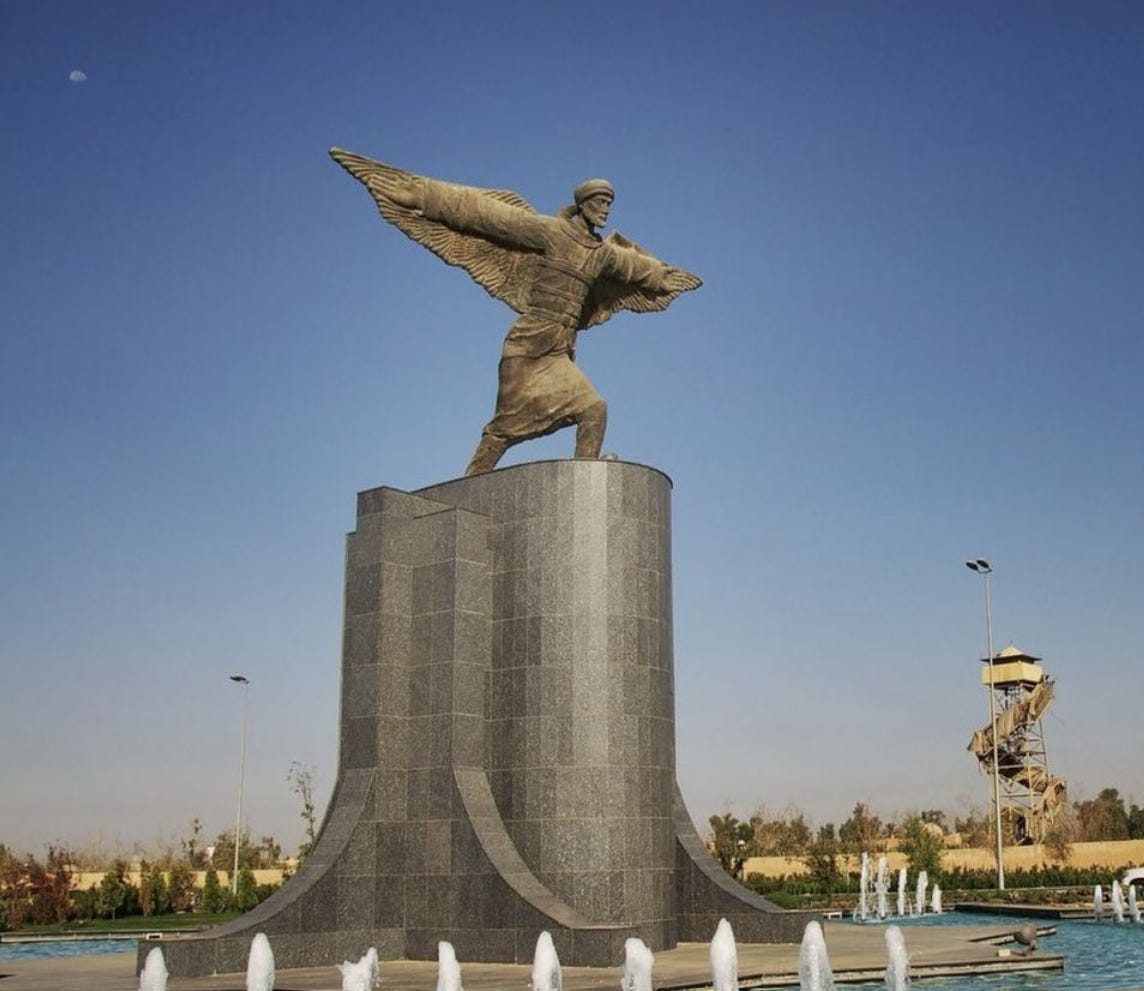
This tradition, focused on displaying the awesomeness of the Islamic world, became a dominant strand in Islamic chronicles from the 12th century, making much of future Islamic historiography worse than worthless. Thus, figures like the 9th century scholar Ibn Firnas were magnified into polymathic titans who built all sorts of wonderful devices – in Ibn Firnas’ case, artificial wings with feathers that he used to fly “for a considerable distance as if he had been a bird,” as the Algerian Ahmad Al-Maqqari credulously wrote in the 17th century, almost a millennium after the event allegedly occurred.
It’s on the strength of this incredible tale for children that Ibn Firnas had an airline, a crater of the moon and a bridge in Cordoba named after him. A statue of the scholar wearing his fake wings stands outside of Baghdad’s international airport since 1973 [see the picture at the top of this post].
Also, despite the millions of people who believe otherwise, Al-Khwarizmi didn’t invent the algorithm. The word algorithm has a great history: it derives from Al-Khwarizmi’s name (“Algorimus” or “Algorisme” in Latin and the first Romance languages), which eventually became combined with the older Greek word “arithmos,” meaning “number,” probably because of a mistaken identification.
Ancient Babylonians used algorithms first, and Euclid popularized them, in “The Elements,” and both Indian and Chinese mathematicians may have used them even earlier. For several centuries, indeed, algorisme did not have the modern meaning – a sequence of instructions to perform a specific computation – but referred to the practice of calculating with Indian numerals using the decimal position system developed in India4.
Muslims were pioneers in many things for which perhaps they shouldn’t have, like the mass enslavement of people across Africa and Eurasia, and this is something that many people prefer to never ever bring up. Why? I did bring it up:
Quick Take: A Look at the Islamic Slave Trade

There’s this pattern in debates about slavery, very visible over the last couple of decades: some virtue-signaler will complain that white people are the worst because they did all this slave-trading and then somebody who knows about history will respond that, well, actually, the Islamic slave trade out of Africa preceded the whites’ by almost a millenn…
Instead of discussing the Islamic slave trade (one which is still alive, at least in marginal places like Mauretania and Texas) people love to highlight the half-legendary story of Mansa Musa, a top slave-trader/king of Mali who once made a fabulous pilgrimage to Mecca and generously spent a lot of the money he made by selling human beings, in the process driving Mali to bankruptcy:
The massive expenses Musa incurred in his trip had no negative impact on Egypt, where his gold was very well received. In reality, the only economy that was ruined by the expenses was Mali’s: there, Ibn Battuta made the acquaintance of Musa’s brother Sulayman (r. 1340-1359), the last great ruler of the state and one that Ibn Battuta found remarkably thriftier than the famous Musa.
In the end, Mali only barely survived Musa. It went into decline and was never again capable of dazzling anybody, being slowly replaced as a dominant regional power by the Songhay Empire.
Look, as I research the Middle Ages, I come across misleading claims about Islamic influence on Western culture every other day, pretty much. It’s just too much: just the other day I came across the claim that various scholars have noted similarities between the Kitab al-Miraj, a 11th century Islamic theological tract by Al-Qushayri (d. 1072) and the Divina Comedia. However, there’s no evidence whatsoever that Dante Alighieri knew of this obscure book (translated to Latin in the 13th century).
I traced back the notion that Dante took elements from the Kitab for his work to Miguel Asín Palacios in 1919, who made it first and most extensively in a lecture for the Royal Academy of the Spanish Language that is full of errors and misattributions.
For example, Asin writes that flatterers in the Comedy suffer the same punishment as drunkards in the Kitab (they are fed a mixture of blood, sweat, pus and rot extracted from the sores of other condemned people), which is downright false: in the Comedia, flatterers are dropped into excrement. Asin also writes of the Comedia taking the idea of fallen angels from the Kitab, even though the idea of the fallen angel is alien to Islamic theology. Come on, people, let’s be serious here.
The history of Islam is long and complex. I know this, because I research it. And the outcome of over a millennium of Islamic dominance in much of northern Africa and Eurasia has been a relative decline in the importance of Muslim lands. Places like Iraq and Egypt, some of the wealthiest and most developed in the world when the Muslims arrived, became some of the poorest and least developed: in the last Human Development Index table, Egypt sits at 100 out of 193 countries, with Iraq at 126.
This is not a reason for satisfaction and celebration: I will always reject the tyranny of low expectations, the idea that nothing more can be expected from these poor Arabs. As a historian, my job is not give Egyptians and Iraqis plaques so that they feel better. My job is to look at their history and try and find what happened; and then to tell it straight, the best I can. That’s what I will keep doing.
It’s worth noting that Antonio García Maceiro, the 19th century Spanish engineer who first came up with the concept of an Arab Agricultural Revolution, was a resolute opponent or Darwin’s ideas, which gives a hint about the solidity of his scientific background.
Some manuscripts were resold on the streets, although it’s hard to say how many and whether any of those was salvaged for posterity, and a tiny number – around 80 – preserved and kept in the Ottomans’ royal library. A related story that the famous Codex Vaticanus, one of the earliest and most complete manuscripts of the Greek Bible, arrived in Italy as part of this alleged salvaging, is almost certainly bogus, since the text appears to have been in Italy from decades or even centuries earlier. Those interested in a full deconstruction of everything that is wrong with Violet Moller’s book should check this highly destructive review.
The industry was much incentivized by the work of Jewish authors who have never quite forgotten Spain for the expulsion of local Sephardim Jews in 1492. This is a separate subject (Al-Andalus was gone by then) and a very complex one, but allow me to single out a famous book written by Harold Bloom. In a festival of errors, blood libels and straightforward lies called “The Ornament of The World. How Muslims, Jews, and Christians Created a Culture of Tolerance in Medieval Spain,” (2002, pp. xi-xii), Bloom wrote that the expulsion represented a “brutal disaster” and the “death of Spain,” although he found that the country did resuscitate after Francisco Franco’s death in 1975.
See “Episodes in the Mathematics of Medieval Islam,” JL Berggren (Springer, 1986).
I for one appreciate your work here, and honesty. Modern liberalism is driven by powerful emotions concerning race, sex and the sacred – what cannot be touched. That's why I call it the sacred victim, entitled parasite culture. In my opinion it stems from the idea of human rights. One merely has to be born in order to acquire privilege. Privilege without obligation.
Although as we see, one is obliged to curb something called "hate speech" if you are a white male. Which constantly changes its perameters, sorta like becoming another sex, I suppose. And yet I would think Muslims are totally opposed to that new modernist "norm."
But, Mamdani forms a coalition with queers, feminists and trannies against the common enemy. Surely, it can't last. Like the Jews pushing for the sacred victim culture and diversity until they realize blacks (who are gaining in power) view them as white. I mean, Israel is what South Africa was 40 years ago.
Great article exposing the myths of wonderful Arabic culture and learning which was actually the work of various cultures and talents forced to take Arab names to keep working in their specialties! The "tolerance" of Islamics who spread their influence "by the sword" were hardly that.