
Quick Take: Top 5 Crazy Things About the Middle Ages
Animal rights, oath divorces, latrine disasters, Tang cosmopolitans and duel aficionados

If you’re not crazy about the Middle Ages, you don’t really appreciate history. The period roughly between 500 and 1500 AD was absolutely bonkers in so many senses that it’s really hard to start with one. Also, we’re not talking about Europe only: the Middle Ages elsewhere, in India, in China, in the Islamic world, in the Americas, definitely were something else too.
This year, and probably in 2027 too, I’ll be extensively writing about everything Medieval, from dark ages to the rise of Islam to China’s golden times to the era of great psychopathic mass-murderers, like Genghis Khan and Tamerlane. Those posts, almost all of which will be paywalled, will be searchable by geography here:

In the meantime, here’s a little taste of five specific themes about this era that I find particularly remarkable, and little known among the general public:
Animalism
It’s hard for us moderns to understand how entrenched within the Catholic Church were the ideas of morality and personal responsibility to uphold God’s law. A good example of this is the widespread, late Medieval view that even animals, being God’s creatures, were responsible for their actions, and were expected to be moral too.
Uniquely in history, the Church conducted multiple animal trials between the 13th and 18th centuries. Now, it’s important to understand that such trials weren’t solely driven by an expensive view of humans’ rights and responsibilities: they also helped to mollify victims and their relatives, sometimes avoiding blood feuds targeting the animals’ owners, which certainly was an additional advantage that many in the Church considered during these prosecutions.
Animal trials were particularly common in France. In the 14th century alone, a sow that killed and ate an infant in the rue Saint-Martin was dragged through the street and hanged, and another pig that mangled a child’s face was sentenced to death by burning. A horse that killed a man and then escaped with its master’s help was convicted of murder in absentia and hanged in effigy. In an apocryphal story, a walled field was reportedly set up in 1372 in the great square before Notre-Dame cathedral for a duel between a man and a dog, and the dog managed to get the man to confess his crime.
In his wonderful book “The Last Duel” (2004), Eric Jager explains the story about the man-dog duel. This was a case centered on the murder of nobleman who was one of the king’s favorites, whose body was found on his estate near Paris:
‘The murder remained a mystery, until suspicion was aroused by the fact that the victim’s dog, an enormous greyhound greatly devoted to his master, always growled and barked at the sight of a certain man. This man, Richard Macaire, was known to have been jealous of the victim’s good standing with the king. When the king learned of the dog’s behavior, he took it as an accusation and ordered that the dog and Macaire be set against each other in a judicial duel. On the appointed day a great crowd gathered around the wooden enclosure set up in front of Notre-Dame. Macaire was armed with a club, while the dog was provided with a large barrel open at both ends where it could take refuge. According to one account, “As soon as the dog was released, it bounded towards its opponent without delay, knowing that it was up to the appellant to attack first. But the man’s heavy club kept the dog at bay, and it ran here and there around Macaire, just beyond the weapon’s reach. Biding its time, turning this way and that, the greyhound finally saw its chance and suddenly leaped at the man’s throat, seizing him there with such force that he dragged him down to the ground, forcing Macaire to cry for mercy.” After Macaire was released from the dog’s jaws, he confessed to the crime and was hanged at Montfaucon. This story appears in many histories of France and was even put into verse by poets, although it may be apocryphal. Yet even if it has little basis in fact, it illustrates the popular belief that a bloody combat between “equals” could yield a just verdict. The king, who reportedly witnessed the duel between the man and the dog, saw the outcome as “a sign of the miraculous judgment of God.’
Just after the Middle Ages, the Frenchman Barthelemy de Chasseneuz (1480-1541) was the most prominent theologian to write extensively on animal trials and acted as lawyer for some of the animals. De Chasseneuz argued that animals “participate” in the created order and can thus be legitimate subjects of judicial action when they disturb it. He also claimed that their involvement in the legal process restores moral order and supports the community’s spiritual welfare, and that the conviction of animals protected humans from spiritual pollution, a common scholastic concept.
As a defense lawyer, De Chasseneuz was fond of citing Old Testament passages where animals that caused death were to be executed “and their flesh not eaten” (as written in Exodus 21:28–29), arguing that the Bible itself recognized animals as proper subjects of divine justice. His story is told, Hollywood style, in the 1993 movie “The Advocate,” one that apparently almost nobody watched and that is not easy to find these days. I’d be more interested in meeting the producer who green-lit such a project than in watching the movie, to be perfectly honest with you guys.
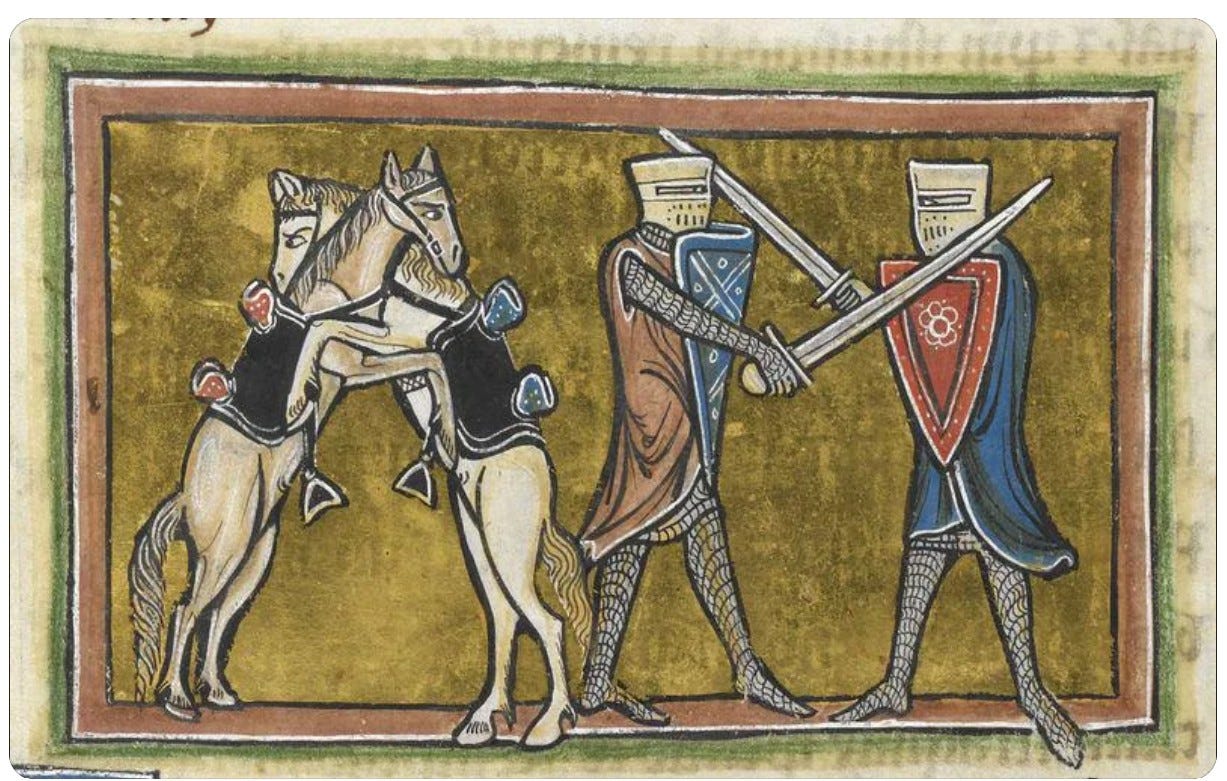
This picture above, by the way, is taken from the Rochester Bestiary, a 13th century illuminated manuscript copy of a medieval bestiary, a book describing a large number of familiar and exotic animals, real and fantastic, with their main moral characteristics.
Oath Divorces
Some of you guys might have heard about animal trials before, but this one truly is for hardcore Middle Age aficionados.
A lot of people act as if the Islamic world was a separate planet during the Middle Ages, and it wasn’t. The Islamic Ummah spread across Eurasia and Africa, being the largest religious bloc of the era, if rarely politically unified, and Islamic law and practices were more significant for most people than Christian law and practices were. This had special significance for women, since Islamic law is not all that fond of gender equality.
Most Muslim women married very early. In Egypt’s Mamluk period, from the 13th century, practically all married not long after reaching puberty, a stark contrast with the practice pretty much everywhere else: in Europe, China and India many women remained unmarried into their twenties. Pious Muslims were particularly fond of marrying prepubescent girls, much like Muhammad had done: the mother of the celebrated Egyptian historian Al-Maqrizi (1364-1442) was married at the age of twelve and Egyptian jurist Ibn Misk Al-Sakhawi (1616-1711) married an eleven-year-old. Orphan girls often were married between the age of ten and twelve, so they would have a guardian.
Early marriages and high rates of divorce meant that a huge number of older women at any given time were single, and many of them joined female religious houses (“ribat,” a word meaning “stronghold” elsewhere used in a military sense) funded by wealthier members of society, where they lived in seclusion, a sort of establishment popular from Egypt to Syria to Baghdad. Ribat evolved to become something similar to Christian or Buddhist nunneries, often led by upper-class women with their own idiosyncrasies a la Hildegard; some indeed functioned not unlike the Low Countries’ Beguines, with women engaged in manual labor maintaining the ribat: “spinsters” as in the Christian West, using spinning wheels to spin cotton and flax.
Many Muslim women and others living in the Ummah struggled to accept a systematic status of legal and financial inferiority: female credit associations, with no real counterparts in either Europe or East Asia, are a common feature in some parts of the Muslim world from the 15th century, with several women pooling their financial resources so they could lend them to others (men and women) for a fee to avoid suspicions of interest payment.
The rise of these associations probably was less of an attempt to compete in the difficult (and dangerous) banking industry and more of an attempt to survive a troubled marriage market. Muslim jurists were unanimous in their interpretation that marriage should not be contaminated by the monetary transactions taking place outside the household, so husbands should not give their wives any money.
Ibn Qayyim al-Jawziyya (d. 1350), a scholar from Damascus, equated the support of wives with the support of slaves: slavery for him and many others, rather than being a contemptible institution, was the exemplary patriarchal model. Thus, Meshullam of Volterra (d. 1508), an Italian Jewish merchant who visited the Mamluk domains in 1481, wrote that Muslim marriages brought women none of the security found in the marriages of Europeans, which explained the high rates of divorce in Mamluk society.
In particular, Meshullam noted that husbands were only required to feed their wives, who were expected to make their own clothes and household items and also provide for their children. And many women, he added, went to court to ask for divorce on the grounds that their husbands didn’t even bring food to the table – a rare complaint indeed either in the European or Chinese tradition, and one that hints at the fact that many Muslims simply forgot about older wives when they took on new ones.
In a famous case, an Egyptian judge only ruled in favor of a wife requesting marital support after she asked her to remove her veil and found her too attractive for the one dinar in annual payments that her husband had arranged: “You wretch! How could you marry off such a beautiful girl like this for just one dinar a year? By Allah, even one night with her is worth one hundred dirhams.” Things were so grim for women that some wives reportedly were in the habit of asking for small cash payments from their husbands before sex, the “bed-fee.”
For lower class women, in fact, marriage was sometimes very similar to a flat-rate prostitution deal. The well-documented travails of Zumurrud, a manumitted slave-girl who lived in Jerusalem at the end of the 14th century, are a good example: she went through various marriage contracts, concluded and then dissolved, to a milk-man for three gold dinars (the lowest sum found in preserved marriage contracts, equivalent to that accorded to Cairene prostitutes forcibly married off); to a manumitted slave for five dinars; and to a weaver for six dinars.
Ibn Battuta, also in the 14th century, noted the custom on temporary marriages in the Muslim Maldives, used as a pretty evident shortcut for prostitution: “Whenever a traveler enters these islands, he may marry for a very small dowry one of the handsomest women for any specific period, upon this condition, that he shall divorce her when he leaves the place; because the women never leave their respective districts. But, if he does not wish to marry, the woman in whose house lie lodges will cook for him, and otherwise attend on him, for a very small consideration.”
Divorce wasn’t great either. In general, it deprived women of support and protection; and if they remarried, the application of Islamic law meant that they were in danger of losing custody of their children, unless she had included appropriate clauses in the marriage contract – which few women were literate and powerful enough to do. The majority of divorces recorded in Egypt and Syria from the 13th century were consensual, but this situation concealed an interplay of legal and extralegal pressured and oddities, so weighty and complex that they may have been one of the reasons for the Ummah’s low fertility rates in a period where many women were supposed to little else other than giving birth and caring for children.
Divorce situations were extremely varied. Some women married and divorced the same man several times, possibly in Zumurrud-style deals. In 1375, Sultan Al-Ashraf Shaban divorced all three of his wives at once. Many divorces were triggered by oaths: as it became common that husbands would threaten wives with divorce, swearing that they would do it if she were to disobey orders not to leave their home or doing something else, marital courts were swamped by such divorces.
So-called “divorce oaths” provide a rare glimpse into the sort of expectations of husbands at a time when Muslim scholars constantly urged them to demonstrate appropriate manly jealousy: thus, married women weren’t supposed to show themselves unveiled or even riding behind a donkey-driver.
Many times, however, divorce oaths were undertaken for reasons external to the marriage, and so merchants would swear on the quality of their merchandise by Allah or divorce, and men would use divorce oaths during quarrels with neighbors or relatives, taking an oath of divorce not to speak to someone or never to stay in someone’s house.
Divorce oaths were also used to escape debt: the jurist Al-Samhudi (1466-1533) devoted a treatise to the question of a man who swears payment on pain of divorce and then claims bankruptcy; he maintained that the court should not dissolve the debtor’s marriage, since an oath of divorce serves to express his intention to exert his utmost efforts; if he did try to pay his debts, he should not be penalized.
At one point in the Mamluk state, divorce oaths became so common that a legal custom emerged that, after a man divorces his wife three times, the spouses are not allowed to remarry until the woman has contracted, consummated and been divorced from an intermediate marriage. Thus, a small industry grew for the arrangement of intermediate – or “tahlil” – bogus marriages, often with slaves expected not to touch them, allowing the divorce counter to be set back at zero.
Hey, I’m just telling you what it was. And it gets worse.
Ordinary couples who couldn’t pay for these services used various tricks: some laymen instructed divorced couples to go on pilgrimage to Mount Ararat, and others believed that having sexual intercourse above a roof or a staircase allowed the wife to return to her husband. Some husbands delivered their oaths in such a manner as to make them unenforceable or argued that their original marriage was null because the father of the bride drunk wine or didn’t attend prayers, or that the couple had already divorced before the divorce oath was violated.
The Damascus-born scholar Ibn Taymiyya (1263-1328), sick of this hypocrisy and (to be blunt) childishness, tried to argue that violation of divorce oaths should merely require atonement, not actual divorce, but was banned from issuing fatwas on the subject and then arrested when he refused to comply. Oath divorces were too big of a deal to be opposed.
Latrine Disasters
Everybody knows about Middle Ages’ squalor and filth, and popular myths about people using dogs to clean up their hands during banquets and stuff like that.
The truth is complicated but, in summary, yes, Middle Ages sanitary conditions were generally worse than during antiquity in western Eurasia and North Africa, because the fall of the Roman Empire led to the collapse of important infrastructures providing clean water and the like.
Few events summarize this situation better than the famous Erfurt Latrine Disaster of 1184.
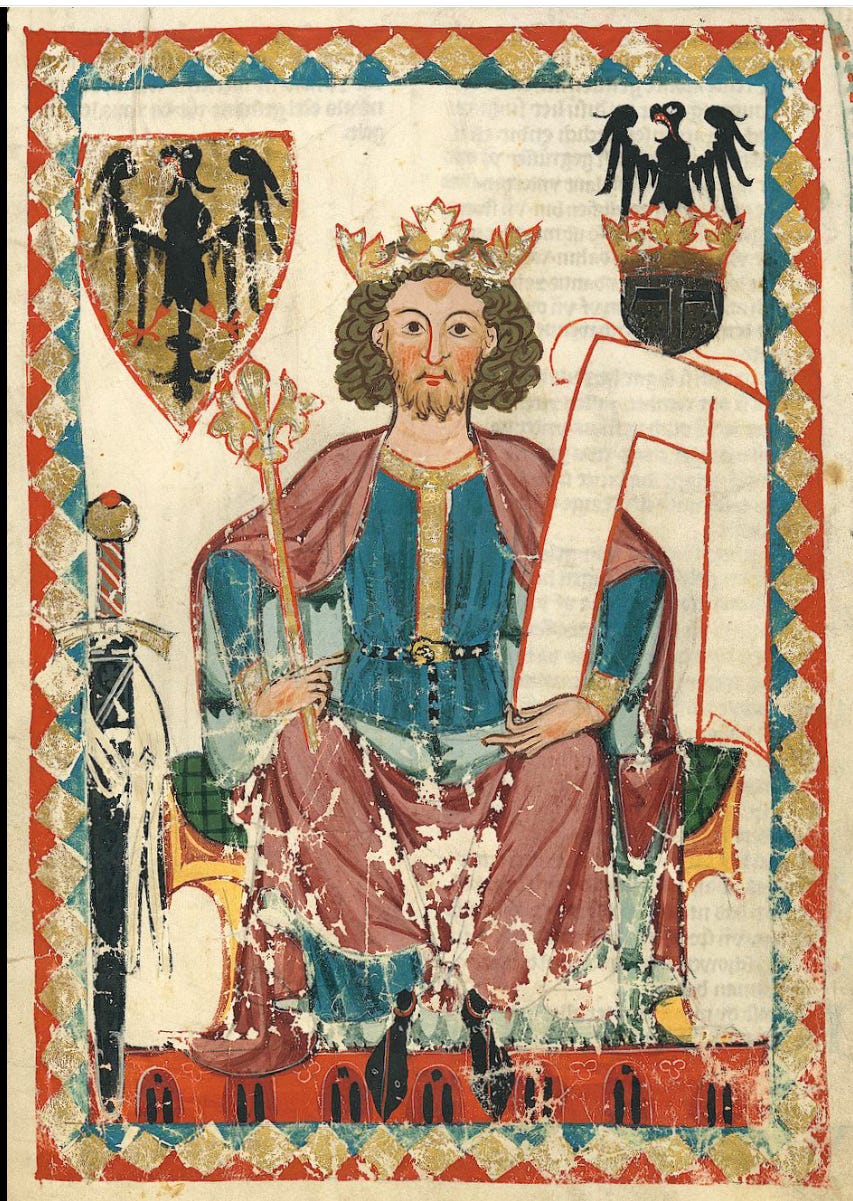
This was a big deal and could have been a much bigger deal. The ambitious German Emperor Frederick Barbarossa sent his son and heir, the future King Henry VI, to take part in an important meeting with noblemen in that strategic city.
Frederick’s ambitions, which he passed on to his son with his throne, were great and had a claim to universal dominion based on the Medieval notion that Holy Roman Emperors, and not the stupid Byzantine Greeks, were the true heirs of Rome; this is something I’ve discussed before:

Anyway, on that fateful day of 1184 about 60 German noblemen meeting with the king in 1184 died after the floor they were standing on collapsed, dropping them into a latrine below, where some drowned. But Prince Henry himself was sitting in a stone window alcove, and didn’t even soil his clothes.
The one silver lining about this disaster is that those noblemen who avoiding drowning in shit had pretty high quality soap to clean up themselves. If you ever travel back in time to antiquity you will notice that Romans and Greeks had to make do with a lot of weird stuff, but by the 12th century authentic soap was commonplace at least among wealthy Europeans (and residents of the Islamic Ummah).
Soap-making, indeed, was one of Europe’s first truly competitive industries. Castile had taken the lead in producing olive-oil based soap in the Islamic style after they took over Andalusia, and this became the luxury soap par excellence for the nobility of northern Europe by the 14th century. However, the Italians soon found way to compete, by finding alkali-rich plants to burn and produce “soda ash” suitable for making hard white soap, at first imported from Egypt and Syria and later made at home. Soon, Italian soap was exported to Greece, Constantinople, Turkish Asia Minor, Rhodes, Cyprus and, in very considerable quantities, back to Syria and Egypt. Those Italians: talk about selling ice to Eskimos.
4 Swinging (Tang) China & Europe
Nothing about Medieval China is not crazy, at least in the eyes of Westerners:
Then again, the craziest era of this period surely is the golden age of the Tang Dynasty during the 7th and 8th centuries.
The Chinese capital at Chang’an near modern Xian – possibly with close to a million inhabitants, a size only matched by Baghdad in the 9th century – was a metropolis of unique complexity and sophistication. The city was divided in various walled wards for better control; beginning in 636, the opening and closing of the gates connecting wards was signaled by prolonged drumming along major thoroughfares; drums were also used to announce the opening and closing of public markets. The way these drums fixed the city’s daily rhythms was dramatized in a popular poem, “Drums in the Streets of the Officials,” written by Li He (790-816):
Drums at dawn rumbling like thunder, hastening the sun,
Drums at dusk rumbling like thunder, calling out the moon.
For much of the year, few people were allowed through the gates at night, including those seeking a physician and those announced a death. For three days during the Lantern Festival, marking the end of the Lunar New Year celebrations, the gates remained open so that people would freely stroll from temple to temple – Daoist, Confucian and Buddhist temples mostly, with some Nestorian and Zoroastrian temples to fulfill the spiritual needs of minorities, foreigners and those intrigued by the local legend of the Christ-like Wen Kang – to watch the lanterns at night.
The city’s Buddhist pagodas were the tallest structures to be seen, and two of them – the Great and Small Goose Pagodas – are the only Tang era buildings still standing in the city as of the 21st century. But it’s the people who lived through this era who were truly unique.
Ambassadors, envoys and visitors from all the states and tribal confederacies surrounding Tang China constantly visited the city, and were expected to appear in their native customs carrying precious objects characteristic of their state. Court painters like Yan Liben (600-674) made a living out of depicting their strange visages – highlighting un-Chinese pointy noises, full beards and curly hair – and outlandish costumes.
Despite the profusion of temples and bureaucrats, Chang’an was an unruly city, crowded with beggars to the point that they were banned from the streets in 734. Even religious festivals were sometimes occasions for excess, with Buddhist processions leading to mass hysteria. In 873 a soldier chopped off his own arm and held it in his other hand as he followed one of these processions.
Among the official buildings, palaces and scenic gardens, huge numbers of waitresses, actresses, singers and prostitutes, many of whom easily switched between the four professions, were on the prowl for patrons and clients, preferably young and wealthy students at the imperial academies – a sight that would have been shocking for residents of Christian and Islamic cities, much more discreet when it came to such business transactions.
Discretion was in short supply at Chang’an, as the Tang writer Sun Qi explained in his “Record of the Northern Hamlet,” a detailed account of the highest levels of the sex trade in the city. High-ranking courtesans were government-registered and often trained in the composition of verse and the performance of music – in every sense, distant predecessors of the Japanese geisha, who only appeared in scene about a thousand years later, in the 18th century. Below them, there were common prostitutes in brothels and other women who could be picked up in teahouses, with various abilities, fees and interests.
The “Northern Hamlet” itself – a traditional phrase used to describe city areas dedicated to the sex trade – was strategically close to the Directorate for the Education of the Sons of the State where upper-class examination candidates who would be the mandarins of the future studied and where others received private tuition. Unsurprisingly, many of such students found it convenient to rent lodgings in that very ward, the better to avoid telling complicated stories to get through the ward gates after they were closed at night.
In keeping with Chinese tradition, many of the locales in the ward weren’t plain, simple brothels, but taverns or teahouses with large common rooms where women could entertain groups of merry men with cash, and smaller rooms where private functions could be arranged for extra fees. Madames, older women with experience in the business, supervised everything and helped to organize parties with drink and Turkish cakes. Financial success was paramount, so many of the women working there supplemented their income by selling herbs and fruit.
Sun Qi tells of a complex world, in which many women ended up because they were sold by poor families, but some were daughters of good families who had been resold by their husbands, who had first purchased them for a bride price, at the time very common in China (and elsewhere). Women who wanted to leave the trade had to pay their price back, often with interest; even visits to temples required fee payments to the madame.
As everywhere else, relations between clients and prostitutes could be unconventional. Many of the young students were drawn to the pleasure quarters not just because of the ladies, but also because of the relationships they could form with fellow party-goers, some of whom would go on to be influential men and good contacts to have. It’s the French who really invented Romantic love a few centuries later, but the Tang-era Chinese came pretty darn close:
5. Non-Duels
Duels are a near-myth of the Middle Ages. There were duels, to be sure, but deadly encounters between men trying to defend their honor or reputation weren’t as common as later authors led everyone to believe.
An example of this is that the grisly 1127 trial by combat in Ypres, Flanders, between Guy of Steenvoorde and his political rival Herman the Iron — ending in an undignified wrestling match won by Guy by squeezing Herman’s testicles — has the highest profile of very few such duels recorded in Medieval Europe until the 14th century.
In theory, duels were allowed to settle not just criminal but also civil cases like property disputes and principals deemed to be not in fighting condition could hire proxies or “champions” to fight in their place. However, the truth is that duels were regulated out of existence from the 12th century. By 1200, duels were disappearing from civil proceedings in France, while in criminal cases it was increasingly limited to males of the nobility. In 1258, Louis IX eliminated the duel from French civil law, substituting for it the Church-style inquisition (“enquête” or “inquiry” involving evidence and testimony.)
It was in the high chivalric era of the 14th century when duels really became a thing, for a short time, and still there are plenty of caveats. Thus, in the process of leading a the rebellion that ended a brief period of English rule, Robert the Bruce fought rival Scottish nobleman John Comyn in 1306 during a secret meeting in a church: although rather than a duel, this seems to have been an encounter that ended in blows and then a fight to the death during which Robert stabbed Comyn before the altar.
Months later, Robert did come close to fighting a true duel against Aymer de Valence (1270-1324), commander of the English forces in Scotland, but De Valence betrayed his oath to fight the next day and routed Robert’s army in a night-time surprise attack known as Battle of Methven. Robert the Bruce’s famous killing of Henry de Bohun, whose head he split with an axe, in the first day of the Battle of Bannockburn – in 1314 – was part of a one-on-one encounter within a larger clash.
The crucial fight between Pedro I and his half-brother Enrique de Trastamara for Castile’s crown, in 1369, falls somewhere in between murder, chance encounter and duel: Pedro appears to have been led unawares to a tent where Enrique waited, but he had a chance to kill him until the intermediary who arranged it all, Bertrand du Guesclin, intervened in favor of Enrique.
As in the 1306 near-duel, for the most part duels were cancelled or stopped before blows were exchanged, or after the participants had been satisfied by exchanging a few blows: when Pedro III of Aragon proposed a duel against Charles of Anjou in 1283, to settle their dispute over Sicily and Southern Italy, both sides found excuses to delay the fight until the parties were buried.
In 1395, Jean II Le Maingre (Boucicaut) fought Galeazzo da Mantova – who defended the insulted honor of Italian knights – but they were separated before they could hurt each other seriously. Three years later, English King Richard II ordered the future Henry IV (Bolingbroke), who had denounced a conspiracy being prepared by Thomas Mowbray, to fight a duel with Mowbray to decide who was telling the truth – although in the end the king cancelled the duel out of concern that whoever won would emerge as a political rival.
Even in duel-loving, love-struck France, in 1296 and 1303 King Philip IV completely outlawed the duel in times of war and peace — although he laterrestored the practice as last resort for certain serious cases, under strict royal supervision. That’s why the last officially recognized trial by combat in France – featuring in 1386 two quarrelsome Norman aristocrats, Jean de Carrouges and Jacques Le Gris – involved such a serious case: they fought over an accusation of rape against Carrouges’ wife.
Ridley Scott made a movie based on Eric Jager’s book about the case, one that has the unique distinction of being more historically accurate than the Encyclopedia Britannica’s entry on the event:
Medieval history has always been surprisingly fascinating for me. I was converted during a medieval European history course in junior college in the summer session at 7:30 in the MORNING!! Expecting to yawn my way through the class, found myself riveted thanks to a fantastic professor.
Thanx
Who knew? 🤷🏻♂️ 🧐 ⏳ 😏