
Quick Take: Who Invented Feudalism?
Feudalism is more of a general feature of history than a specific European oddity, first evolving in Pharaonic Egypt, China and India, and only later becoming a political system in Europe

(This post is in response to a question from a paying subscriber, Hooly, who is intrigued by Hyun Jin Kim's thesis that the system of 'feudalism' — one that Europe came to practice after the fall of the Roman Empire — actually originated with the Central Asian nomadic confederations, including the Huns and later the Avars, and perhaps was influenced by the complex aristocratic system arranged in China during the Zhou Dynasty from around 1000 BC.)
When one writes about “feudalism,” most Westerners think about Game of Thrones-style Medieval fantasies with stinky peasants and haughty knights lording over them. But feudalism is more of a general feature of history than a specific European system, and first evolved in Pharaonic Egypt.
The first dynastic cycle in Egypt — the “Old Kingdom” during which the biggest pyramids were erected — lasted for close to a millennium, and ended after the long reign of Pepy II, who died in 2184 BC and appears to have been a rather ineffective rule. Pepy was succeeded by an elderly son, who reigned for just over a year, and then by the picturesque Netjerkare Siptah, the last real pharaoh of the Old Kingdom, who was believed to have diverted the Nile to drown some enemies.
After Netjerkare's death, seventeen people are listed as pharaoh over the next twenty years in Manetho's list – the first historical example of a pattern lately to repeat itself across cultures, under which long periods of same-man rule are often followed by much shorter reigns and court instability, as elites struggle for power and, especially, to stop another long-lived ruler from taking over for decades on end. What follows is a complex tale that I already discussed here…
… but, in a nutshell, we come across what Egyptologists call First Intermediate Period (until 1936 BC), characterized for the rise of multiple power centers led by warlords, and a complete end to large-scale monumental projects. Herakleopolis, in Middle Egypt, and Thebes, Upper Egypt, struggled for domination for much of this era.
This is the first time in history in which a sort of feudalism appears. It will present itself at several other points in ancient Egypt, under various guises, but the phenomenon will keep a series of basic, common features. It often arises from a weakening central state in which governors slowly grab enough power so that they can pass on their positions of privilege to their descendants, until a point in which the sovereign is a primum inter pares, only the most powerful noble in the realm, or just the most revered – or, in some cases as that of the First Intermediate Period, kingship itself is disposed of, and warlords become independent rulers of smaller realms.
The feudalization of China’s Zhou Dynasty from the early 1st millennium BC followed the Egyptian model pretty closely and, as in Egypt’s case, had nothing to do with barbarian invasions and everything to do with a decreasing ability of the center to hold the peripheries.

Interestingly, future periods of feudalization in China were connected with external invasion, and that’s also the way in which “traditional” European, post-Roman feudalism settled into the Middle Ages: as a type of feudalism derived or at least helped by the establishment of new barbarian kingdoms in which kings were never the all-powerful progeny of gods or their prophets.
In these cases, and others in the future such as late Medieval Russia as well as Ghurid and Mughal India, what we see is local chiefs who created local aristocracies, elevating local elites to positions in which they didn't need to aspire to move to the great ruler’s court to consider themselves accomplished and successful.
This was most striking in 1st millennium China — with big imperial capitals in Chang’an and Luoyang — where we see a clear Egyptian-style breakdown in the pipeline moving accomplished officials from provincial elites to the imperial capital. That is particularly the case after the fall of the Eastern Han dynasty in the 3rd century, and later during the century of disruption between the Tang and Song dynasties just before the turn of the millennium.

All in all, feudalism was a reality across most states of Eurasia since the slow-moving collapse of the Roman Empire started in the 4th and 5th centuries, in coincidence with the roughly contemporary decline of India’s Gupta Empire and the final phase of China’s reunification, culminating in the rise of the Tang.
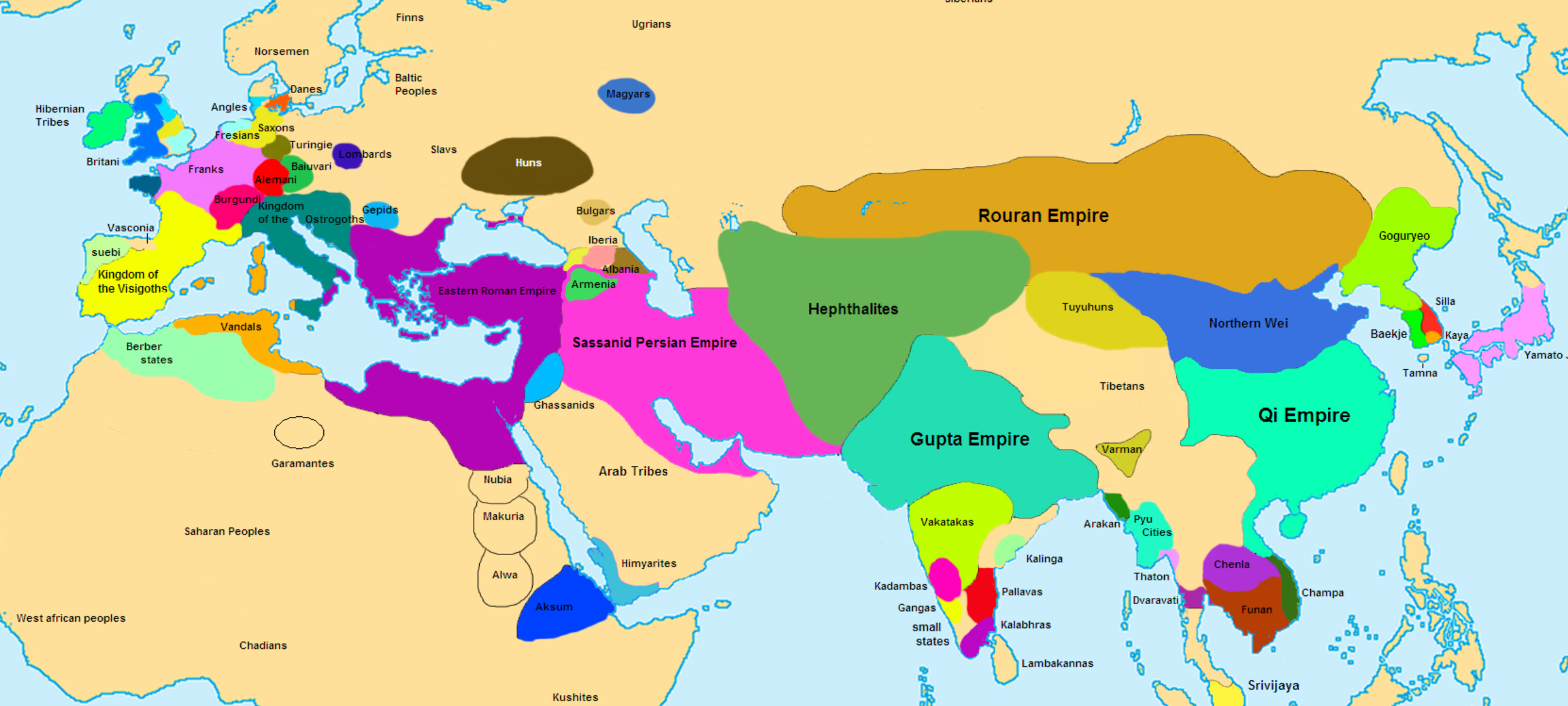
Still, only Roman Europe and Han Dynasty China were overrun by steppe barbarians, and these not entirely — imperial China survived in the south for centuries, under various guises, much like the Byzantine Empire survived as an often very powerful, dominant empire in western Eurasia — while others were little affected by steppe invasions at this time: certainly the feudalization of Egypt, India and even parts of the Sasanian Empire had little to do with barbarian invaders who only made a small impact, if at all, on those lands.
Contra Hyun Jin Kim's thesis, the seeds of feudalism everywhere were sowed by states facing a shrinking capacity to raise monetary taxes from peasants subject to recurrent bouts of political instability, and an effective end to centuries of urban expansion, as such instability had a negative impact on trade routes and food availability. With fewer merchants, artisans and tradesmen to tax, states retrenched and went to the basics of ensuring that peasants would provide royal courts and cities with sustenance, in exchange for a degree of protection.
This meant that governance of the countryside was in many places, if not everywhere, a more attractive proposition for aristocrats and higher officials than positions in cities. The cooling spells that caused plagues and famines over the period (the last recorded in Mediterranean Byzantium was in 767, in southern Italy), leading to a contraction of populations in most the regions from which anything resembling reliable numbers exist, contributed to incentivize land-holders to see themselves as people-holders: the fewer peasants there were, the more important they were.
This was a double-edged sword, since it also gave peasants leeway to avoid the most onerous extractions, in exchange for remaining with specific land-lords. Throughout the second half of the 1st millennium, state rulers and aristocrats oscillated between carrot and stick policies to deal with the situation; in the end, the deciding factor that made feudalism a system clearly benefiting the upper classes was the degree of urbanization.
In China and India, and in much of the Muslim world after the rise of Islam, city life survived the upheavals and eventually flourished again. This was partly because relatively smaller political disruption, compared with the massive cycles of invasion and destruction across much of the former Roman Empire and other places, contributed to the maintenance and development of better agricultural technology, even in drier places hit by a cooler climate like the northern Chinese plains, making agricultural production less reliant on masses of peasants.
Such developments made urban centers easier to feed and relatively bigger in size, as well as more attractive for peasants fleeing oppression, which helped to keep feudal lords in check. That is why the Caliphate was able to, in essence, maintain pre-existing Roman and Sasanian tax systems and was relatively cash rich, while only some features of traditional feudalism were found, at times, in parts of contemporary China and India. In China, in particular, the strength of urban life during the Tang Dynasty made a massive difference, evident in the fact that feudal conditions became much more apparent during the country in the centuries that followed that dynasty’s downfall.
In much of Europe, the opposite was the case. By the turn of the millennium, none of the eight largest cities in Western Europe – Cordoba, Seville and Toledo in Al-Andalus, plus also Islamic Palermo, and Christian Salerno, Venice, Regensburg and Rome – had a population of more than 150,000 people.
European states, particularly those in the West, were eventually cut off from the main international trade routes and cities took much longer to re-emerge from their post-Roman collapse and regain anything close to their former influence. With nowhere to go, European peasants from the 6th century as a rule found themselves with a poor bargaining position; much the same can be said of isolated Christian lands in the Caucasus like Georgia and Armenia, where a long tradition of feudal relationships held for centuries.
Feudalization in much of Europe might be explained by a continuation of Roman trends alone, but it wouldn’t explain why places that were never ruled by Romans feudalized at a similar pace as those who were. The fact that feudalism quickly spread well beyond former Roman borders, being an obvious feature of daily life in 6th century southern and central Germany, is further evidence that it was highly correlated with low urbanization: even as a large share of the Germanic population moved southwards during the collapse of the Western Roman Empire, those who remained stayed faithful to clannish and tribal lifestyles that derided cities.
The same goes for Slavs, who contributed to Germany’s feudalization through their migration west – since it forced many locals to coalesce around local patrons and protectors – and later adopted social patterns with clear feudal characteristics despite the fact that they had little to do with old Roman feudalization trends1.
Such factors gave European lords a bigger, or at least stable, pool of available farmhands. This is why eventually European historians coalesced over a concept of “Middle Ages” in between the urbanized Roman period and the re-urbanized Renaissance period from the 14th and 15th centuries, and those in other regions didn’t really perceive the same clear divide.
Feudalism never existed anywhere in a perfect, model form, even in Western Europe. Various features of feudalism were more dominant at different times across different places, and the feudalistic ideal may be said to have found its most perfect form, the closest shape to the model, in France and Frenchified Britain after the Norman conquest.
Those states become a sort of feudal benchmark from around the 9th century, but not earlier. Even very weak Merovingian kings controlled by their mayors retained the power to appoint counts, an office from which one could be relieved before it later became an aristocratic title2; dukedoms, likewise, were often created and dissolved, before they became a permanent territory controlled by dukes, under the Merovingians as under the Romans mostly the equivalent of generals in command of specific regions at the king’s theoretical pleasure.
Northern Italy and the middle Rhineland, where similar patronage arrangements were adopted early, temporarily evolved into the closest example to this model, before a rebirth of city life changed things after the turn of the millennium. And, even there, things were never as clear cut: peasants in Lombard Italy sometimes used titles – particularly vir devotus and vir honestus – probably inherited from Roman military ranks, betraying deep social resistance to any neat division of society between serfs and landlords.
In fact, peasant uprisings against aristocrats perceived to be exploitative are a feature of later centuries and only start to appear in chronicles with any regularity from the 9th century. The Game of Thrones-style worlds of modern fantasy literature reflect the so-called High Middle Ages, an era of huge social and cultural complexity and unmatched economic and demographic growth, one that most definitely was not all about stinky peasants and haughty knights, and already had quickly growing cities whose merchants and scholars would soon coordinate with royal courts to effectively end the feudal period in Europe.
As Chris Wickham writes in his masterful “Framing the Early Middle Ages: Europe and the Mediterranean, 400-800” (Oxford UP, 2006), “the process by which free tenants slowly lost status and unfree ones slowly gained it, both as a result eventually meeting in the category of ‘serf’” is a cliché in medieval historiography, but a useful one: a simplified explanation of the European feudal process is that unfree tenants in the former Roman empire and free tenants north of the Danube all converged in the category of serf.
Even freedmen could be, and were, appointed counts, as J.B. Bury put it in his wonderful “A History of the Dark Ages - From the Triumph of Constantine to the Empire of Charlemagne,” (Didactic Press, 2015): “Leudastes, the Count of Tours who quarreled so violently with Bishop Gregory, had been born on an estate belonging to the royal treasury in the island of Rhe, and had been employed as a slave first in the kitchen, and afterwards in the bakery of King Charibert. Having run away several times he had been marked by having his ears clipped. Charibert's wife had only lately freed him when the king appointed him Count of Tours. The counts were chosen not only from all classes of society, but from the various races of the kingdom. Among those who are known to us there are more Gallo-Romans than Franks.” At the same time, vicars originally were secular offices, for those below the rank of count, which eventually ended up associated with the Church.