The First Muslim Revolution
A History of Mankind (391)

The Abbasid revolution that put Abd al-Rahman I on the run and ended with him in Al-Andalus was the result of long-simmering dissension and discontent with the Umayyad Dynasty, seen as out-of-touch with the realities of increasingly complex Caliphate politics.
As the number of conversions to Islam soared after Umar II simplified the process to the utmost and made it clear that no Muslims would be required to pay jizya regardless of their ethnicity in the late 710s, tax income declined in the same proportion. Meanwhile, his efforts to offset the loss by making everyone, including Muslims, pay land taxes (kharaj/kharadj) did much to make everyone, including Muslims, angry with the Umayyads.
All over the Caliphate, huge numbers of people converted explicitly to stop paying jizya, with such conversions becoming particularly noticeable in areas where Christianity had never had a very firm footing to start with, including Khorasan, the Maghreb and the Iranian plateau.
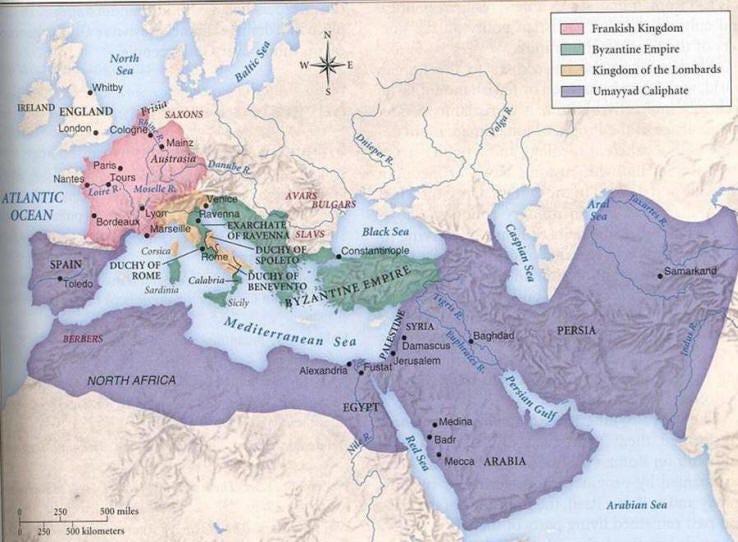
This flood of newly-minted non-Arab Muslims (called “mawali”), often with little or no religious sincerity whatsoever, drove much of the ethnic and class tension that eventually erupted in the Berber Revolt of 740, and left much of the Muslim land west of Egypt under, at best, tenuous control by the Caliphate. It also triggered the appearance of the first scholars with clear claims to religious authority1 – like the Yemenite Wahb ibn Munabbih (d. 737) – as self-appointed protectors of Islamic purity2.