
When China First Spilled Out Into the World
A History of Mankind (370)

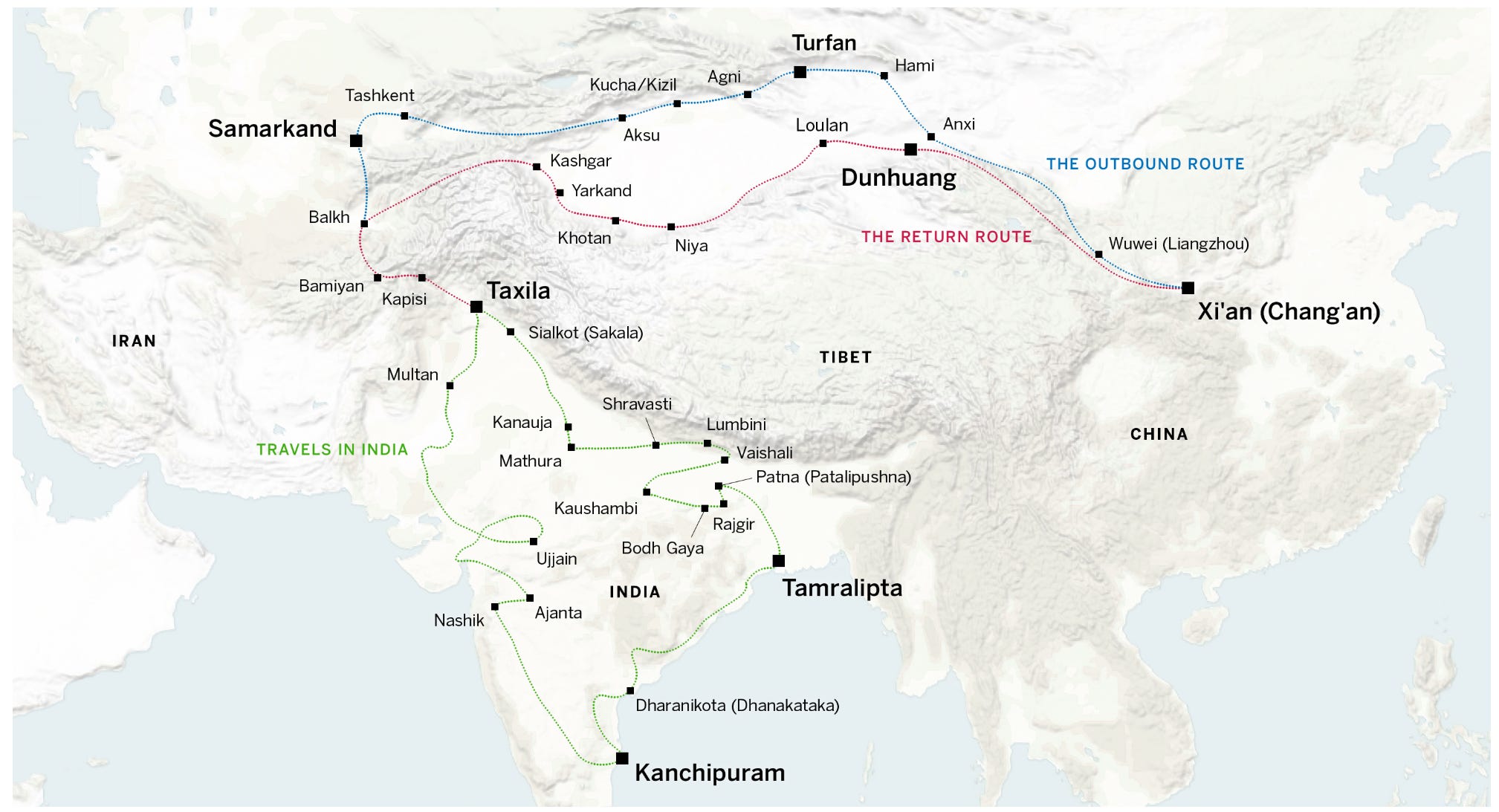
In 629, the Chinese pilgrim Xuanzang started a 17-year trip to India. The book he wrote after he returned home from his long adventure across the Himalayas remains one of the most interesting travelogues of the entire first millennium.
A Buddhist monk born of a wealthy family, Xuanzang’s descriptions of his travels across Tibet, Turkic-Iranian lands in Central Asia – modern Kyrgyzstan, Uzbekistan and Tajikistan – and into India are a key example of Chinese orientalism: he often writes of desolate lands, huge lakes, imposing mountains covered in snow, all part and parcel of the landscape; and he also sprinkles warnings about dragons haunting the routes, and super-natural prodigies to be found in remote corners; he recommends avoiding red-colored clothing in the Himalayas, since it seems to be particularly appealing to dragons1.
When they sound plausible, Xuanzang’s observations often are intriguing: visiting a Turkic court along the way, he notes that, as his hosts are fire-worshippers they do not use wooden seats, since wood has “the principle of fire,” which explains why they sat on the floor using double mats as seats2. For Xuanzang, the Turkish Khagan provides an iron-framed bench with a mattress. Having dined roasted beef and mutton with cakes, milk, candy, honey and something called “wine syrup,” with the accompaniment of music, the Khagan is remarkably contemptuous of India:
“You need not go to the country. That land is very hot, its tenth month being as hot as the fifth in this land. Judging from your appearance I fear you will not survive a visit; its people are contemptible, being black and uncivilized.”3
More importantly, Xuanzang had an interest in politics and in the description of Indian political arrangements and customs of the time. Language and cultural barriers limit the usefulness of his account of the trip: at one point, for example, he quite implausibly states that in India people who violated filial piety either had their nose and ears or hands and feet cut off, or that they suffered exile or banishment – clearly an attempt to stress such piety, so beloved by the Chinese.
Wang Xuance, the other outstanding 7th century Chinese visitor to India, travelled there as a diplomat commissioned by Emperor Taizong. His embassy certainly wasn’t very successful, given the military entanglements he found himself drawn into, but his report with notes on both India and Central Asia provided Chinese officials with much valuable information – indeed, one suspects, information that was more actionable than Xuanzang’s musings4.
Taizong also elevated and protected the famed scholar Kong Yingda (574-648), who served in the Imperial Academy founded by the Sui, and from there led the efforts to publish the massive compilation “Corrected Meanings of the Five Classics” (“Wujing Zhengyi”). This work became the standard curriculum for imperial examinations as well as well as the basis for future scholarly work on China’s best-known classics5.
For all his successes, karma eventually caught up with Taizong. Over the last few years of his life, this man who had murdered two of his brothers and many of his nephews to ensure his accession was fated to witness his many children fight each other for his succession. He ordered the execution or confinement of several of them, including his eccentric firstborn, who was fond of dressing like a Turkic lord; and it was his ninth son altogether, the sickly Li Zhi, who became Emperor Gaozong when Taizong passed away in 649.
Gaozong, born in 628, only governed for about a decade, during which he became the first Chinese emperor to receive an envoy from the Muslim caliphate, in 651. By 665, several strokes left him so incapacitated that he delegated all of the day-to-day business of his reign to his wife Wu Zetian (624-705) — previously, one of Taizong’s own concubines — while he watched proceedings from behind a screen.
Wu Zetian, perhaps the most famous empress in Chinese history, was a seasoned player in Taizong’s harem with a unique path to power. Like other childless concubines, she was forced to become a Buddhist nun after the old man’s passing, and her rise to absolute power was typically signaled by the blood-stained marks of in-fighting between prominent court women.
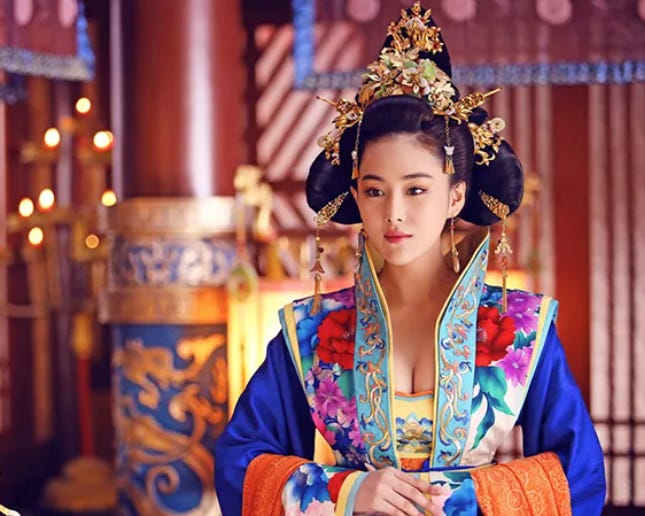
She was taken out of the monastery, told to grow her hair back and effectively pushed into the emperor’s bed by Gaozong’s own wife, Empress Wang, who was barren. Empress Wang was concerned about the competition posed by one of the emperor’s concubines, Consort Xiao, who had given him a son. Consort Wu, as the future empress was then known, thus feigned to act on Empress Wang’s interests, while plotting to replace both her and Consort Xiao.
An accusation of witchcraft was the time-tested instrument that the well-educated Wu Zetian eventually used to remove both rival women from the court: also accused of trying to poison the emperor, they both were put under house arrest until the new Empress Wu secured enough political capital to have them tortured and executed6.
Wu Zetian’s fertility then was one of her secret weapons: between 652 and 662, she gave the emperor four perfectly healthy sons, all of whom would later quarrel with her, and two of whom eventually joined the very long list of people the empress had murdered. Another of her advantages was that, at a time when China didn’t face external existential threats, she wasn’t overly concerned with foreign policy and expensive military campaigns: in the four decades during which she effectively ran the state, Chinese borders expanded to their largest extent yet, but only modestly compared to those of the time of her former paramour, Emperor Taizong.
In 666, the then-ailing Emperor Gaozong held a grand religious ceremony at Mount Tai in Confucius’ Shandong, attended by representatives from Japan, India, the caliphate, Chenla in Indochina, Korea, the Sasanian court in Chinese exile and Turkic vassals, an event that marked the height of his foreign policy influence. From that point and for decades to come, Chinese armies mostly stayed on the defensive – a new state of affairs that was first evident when a major and very complex, land-and-sea campaign into Korea, one that was Gaozong’s brainchild and pet project, was left unsupported7.
The Korean campaign thus petered out over the 670s, when the so-called Silla-Tang War ended with a stalemate leaving China in control of the strategic Liaodong Peninsula and most of the old state of Goguryeo – next to a strong, now unified state of Silla ruling almost the whole of the Korean peninsula, replacing the previously divided Korean political landscape8. Late in the same decade, the eastern Turks, once subdued by Taizong, rebelled against China and started to rebuild their old steppe empire; in 682, Ilterish founded the Second Turkic Khaganate, sharing control of the Mongolian steppes with the always dangerous Khitan tribesmen.
FROM THE ARCHIVES:
Likewise, Wu Zetian only grudgingly supported military efforts along the Himalayan border with the Tibetan Empire, and this almost certainly because of alarm in court when the Tibetans effectively allied with the Turks of Xinjiang to try and dislodge the Chinese from the so-called Four Garrisons of Anxi, formed early during Gaozong’s reign. These garrisons, controlling the Tarim Basin along the main route connecting China with Western India and Iran, were the focus of much fighting during the second half of the 7th century, and remained a target of Tibetan attacks long after Empress Wu’s death.
Judging by previous Chinese history, the rise of strong military leaders would have been dangerous for Empress Wu, given that it was such generals precisely who specialized in removing cunning women from power. Since the empress’ main concern was domestic politics and the protection of her own role at the center of it, that would explain the empress’ reluctance to empower the army so that it could handle the threats along the borders.
That would also explain why she clashed with the aristocracy in the 660s, seeking to open palace examinations to more and more commoners: such a move helped to dilute the power of great clans who were scornful of her own social origins, as the daughter of a timber merchant who had slept her way to power across two reigns9.
Her feuds and vendettas against possible court rivals were endless, and necessary to keep her in power in the circumstances. Multiple officials and court ladies were jealous of her power and influence and conspired to stop the emperor from officially appointing her as regent. Her eldest son and crown prince, Li Hong, was one of those and she almost certainly had him poisoned to death in 67510; her second son and subsequent crown prince, Li Xian, was another, and he was demoted five years later.
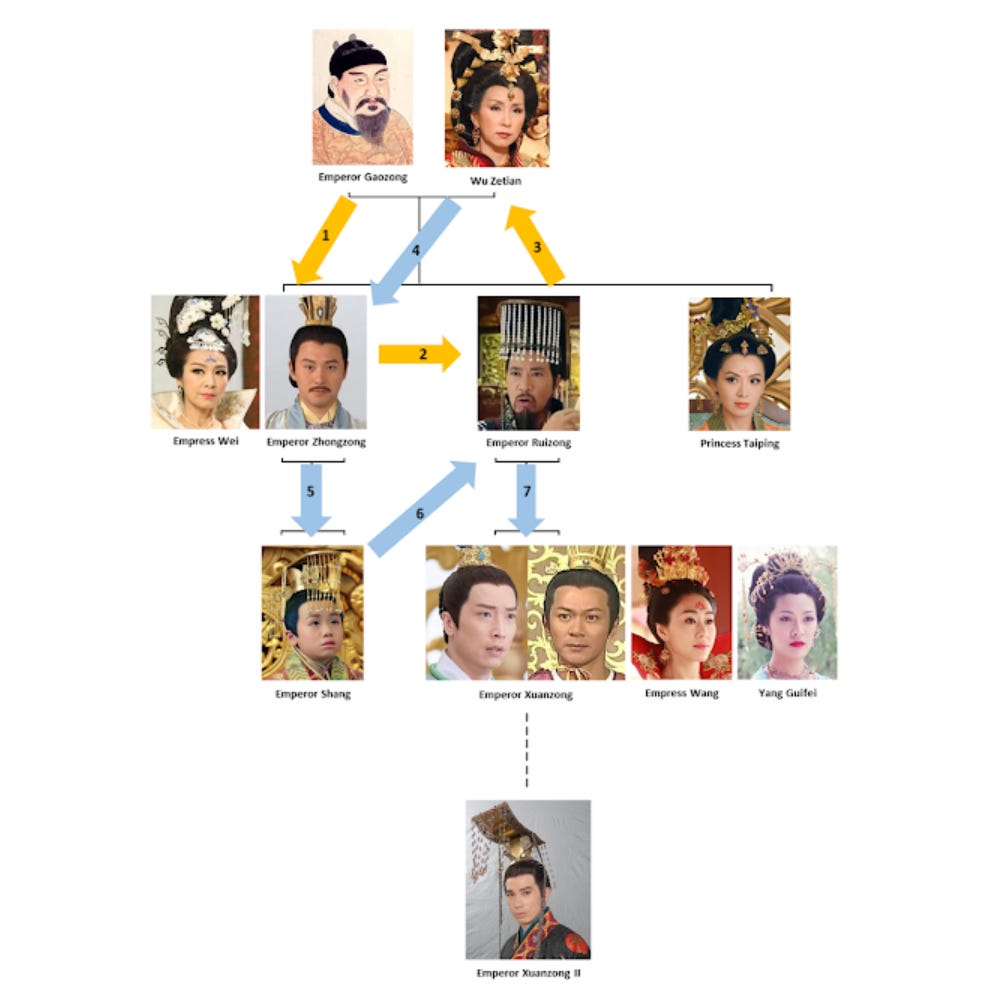
By the time Gaozong died in 683, Empress Wu’s position atop the state was mostly based on her extensive network of informants and clients and the fact that she was the mother of the third crown prince, who took the crown as Emperor Zhongzong with a very understandable fear of contradicting the dowager empress. This fear, however, wasn’t shared by Zhongzong’s wife, who immediately set out to plot against and dislodge her powerful mother-in-law from the court.
The plan didn’t work: within six weeks, the emperor was deposed by her mother and her cronies, and replaced with his younger brother, enthroned as Emperor Ruizong with her as plenipotentiary regent. For good measure, Empress Wu also forced her eldest surviving son, Li Xian, to commit suicide.
In middle age, celebrated by her court, protected by her agents and feared by her two surviving sons, Empress Wu became a fearsome presence in court. In a poem attributed to her (“A Tour in the Imperial Garden on a Spring Day”), the empress bosses the God of Spring around:
“I will go to the Imperial Garden tomorrow
Let the God of Spring immediately know:
All the flowers must be in bloom overnight,
No need for morning winds to blow.”11
She also grew bolder: she took a lover whom she made a Buddhist monk and crushed imperial family members who failed to show the appropriate respect for the throne; many were massacred and some starved to death. In 690, Empress Wu took the ultimate step no dowager empress, no matter how astute and calculating, had ever taken, and grabbed the throne for herself, setting aside Emperor Ruizong and founding what she called Zhou Dynasty, a fifteen-year period that combined shrewd policy making with regular purges and executions.
Given the empress’ multiple Buddhist connections, it’s no wonder that during her reign Buddhist penetration into all aspects of Chinese life continued. She commissioned a translation of the Great Cloud Sutra with a commentary that prophesied that a female Buddhist ruler would rule the land; to make the point easier to grasp, one of the authors of the translation described the empress as a reincarnation of the Buddha Maitreya12.
The monasteries kept expanding their power, safe in their dual role as tax havens for the rich and source of alms for the poor. Buddhist monks ran huge estates and manufacturing operations, as well as lending institutions, taking a feudalistic approach to the farmers tending their lands, not unlike that of the similarly minded Catholic Church on the other side of Eurasia.
Key distinctions remained between the two, however: the Church was a well-structured, top-down organization with the Roman pope and various patriarchs (notably those of Constantinople, Alexandria and Antioch, but also many others) at the summit and bishops in between themselves and rank-and-file priests, monks and nuns; meanwhile, the Buddhist sangha was highly decentralized, with a large numbers of power centers in monasteries across Asia.
Even in devout Tibet, the rise of monastical power was slow and the first Dalai Lama, recognized as such only after his passing, lived in the 15th century. Within China, there was never a top Buddhist priest who commanded the respect and obedience and others. Xue Huaiyi, Empress Wu’s lover who became a Buddhist monk13, received great honors from her but never really dreamt of becoming a leader of the faithful – when the two fell out, it was because she took another lover, and the empress saw, in keeping with her style, no other way out other than killing him.
The fact that Huaiyi was supposedly a high-ranking monk at the time caused no consternation and didn’t result in clerical displeasure in the way that the murders of Gaulish bishops by contending Merovingian dowagers – just a few decades earlier – did much to lower the dynasty’s reputation in the eyes of the religious.
The Roman Empire had accepted, and even encouraged, a political role for Christian clergy since the 4th century, when it became evident that the collapse of overtaxed provincial elites had left a void that the Roman state was not prepared to fill. Across Christendom, and particularly in Western Europe and Byzantine lands, the Church over the 7th century reinforced its role as intermediate estate between secular powers and the governed, with bishops and patriarchs receiving all sorts of dispensations and being granted significant powers to rule cities, act as welfare providers and infrastructure repairers.
This never happened anywhere in the Buddhist lands, at least until the rise of more politically-minded Buddhist leaders in Tibet and Southeast Asia, because Asian states had never allocated any such role to religion. Movements that attempted to breach this divide and make the transition into political activism, like China’s Sanjiejao, were ruthlessly suppressed. Empress Wu herself proscribed the sect again during her time as sole ruler, like the Sui emperors had done before, and like her grandson, Emperor Xuanzong (r. 712-756), would later do14.
A legacy of Empress Wu’s relentless drive to stay in power and stop any aristocratic bloc from rising against her was the reinforcement of China’s imperial system. After her reforms, the Tang Dynasty displayed a surprising level of social mobility15 that ensured a steady supply of talent for official positions, at a level not seen since the Han Dynasty. Wu Daozi, possibly the world’s best-known painter of the 8th century, grew up as an orphan during her rule and later served as court artist for Emperor Xuanzong: a Chinese legend has it that he once painted a mural so lifelike that one day he walked right into it, never to return.
As in other eras characterized by high levels of murder at the court, life in the provinces was comparably tranquil, except for the occasional barbarian incursion, like a very destructive Khitan raid into Hebei in 696. China avoided civil wars and even significant uprisings for decades, leading to prosperity, demand for luxury goods and growing trade, driving a higher circulation of currency. As the upper-classes strove for sophistication, Indian and Iranian astrology became fashionable, and integrated into Chinese Buddhism and Taoism16. For the first time in centuries, a united, confident China was primed to regain the privileged, unassailable position it had once enjoyed under the Han, even if for just as brief a period.
To read previous posts in the History of Mankind, which is pretty long, you can click here. Make sure to become a paying subscriber because most are pay-walled.
See “Xuanzang (Yuan Chwaig) Travels in India,” translated by Watters, Thomas (1904), Royal Asiatic Society. Xuanzang was a bit of a dragon connoisseur, Watters explains: “The pilgrim’s description proceeds to relate that in the eastern part of Kuchih there was a large Dragon-Tank in front of a Deva-Temple to the north of a city. The dragons of this tank changed themselves into horses, and then coupled with mares: the offspring of this union was a fierce intractable breed, but the next generation formed fine horses patient of harness, and of these there were very many. Local tradition told of a king in recent times named Gold-Flower who by his regal ordinances and judicial impartiality moved the dragons to become his vehicles, and when he wanted to die he touched the dragon’s ears with a whip, whereupon he sank out of sight with them to the present time. There were no wells in the city and the people drew water from the Tank: the dragons now changed themselves into men and had intercourse with the women: the offspring of this union became daring and fleet as horses, and all the inhabitants gradually came to have a mixture of the dragon in them; trusting to their might they made themselves feared, and came to slight, the king’s commands, whereupon the king brought in the Turks who slew all the living creatures in the city, and this was now a jungle without human inhabitants.”
An anthropologist might perhaps have speculated on how the custom of sitting on the floor of tents is explained by the scarcity and value of wood in the steppe, since it’s fuel for fire in long, cold nights.
Xuanzang himself wasn’t above providing cruelly critical descriptions of the people he encountered. He describes the people he calls Suli, perhaps ancestors of the Tajik, thus: “They cut the hair even leaving the top of the head exposed, some shave off the hair, and they bind the forehead with a silk band. They are of large stature but of a cowardly disposition: they are treacherous and deceitful in their ways and very avaricious. Father and son scheme for gain: wealth gives eminence. There is no distinction between the well-born and the low-born: one who is extremely rich may live on poor food and wear coarse clothing.”
Altogether, more than fifty Chinese diplomatic missions visited northern India between 637 and 753, often in search of allies against Tibet. Mark Edward Lewis, “China’s Cosmopolitan...,” Op. Cit., p. 157.
For each classic, Kong and his co-editors selected what they deemed the most reliable commentary and to it appended their subcommentary, which mainly amplified the arguments of the commentary. Nylan (Op. Cit.) notes, however, a key development evident in this work: “Between Han and Tang there lay a major difference: for generations of dedicated Han classicists, the compelling motive was personal immersion into the presumably unified moral perspectives of the Classics’ sage-authors, whereas for the Tang scholastics seeking to recover and revive… learning, it was the classical texts and their prescriptions of duty (yi ) that constituted the primary hermeneutical concern.”
Consort Xiao’s sons survived this purge, but were murdered by Wu Zetian decades later.
This campaign was, in some ways, the most successful ever conducted by Chinese armies in Korea. One of the armies conquered the state of Paekche, occupying much of the peninsula’s western coast. Despite a lack of supplies and large-scale reinforcements, the Chinese held the territory against a widespread rising supported by Japanese ships in 663.
From 676, the border between China and Silla was along the Taedong River, now roughly running through the middle of North Korea.
She also had her own Wu clan listed on the aristocratic register of Great Families.
In “Empress Wu the Great,” X.L. Woo (Algora Publishing, 2008) argues that it’s unlikely that Empress Wu poisoned her son: “it was long understood that Li Hong was already suffering from tuberculosis, which could not be cured at that time. Why should his mother take the trouble to poison him?” (p. 90)
X.L. Wu, Op. Cit. p. 174.
Mark Edward Lewis, “China’s Cosmopolitan...,” Op. Cit., p. 222.
In his previous life, he had been a handsome, well-built hawker selling herbal medicines. She only made him a monk to have an excuse to bring him often to palace; as X.L. Wu puts it, “as she was known as a devout believer in Buddhism, it was reasonable for a monk coming into the palace to read the Buddhist sutras to her.” (Op. Cit., p. 151)
Hubbard, Op. Cit., p. 190. As Hubbard notes, the Sanjiejao’s reiterated rejection of the capacity of earthly monarchs to exercise divine rule and in general realize harmony made the sect very powerful enemies indeed.
Cit. “Social mobility in the Tang Dynasty as the Imperial Examination rose and aristocratic family pedigree declined, 618–907 CE,” by Fangqi Wen et al, PNAS, 18.1.2024. Drawing from 3,640 epitaphs of males as well as other data from reliable historical sources, such as dynastic records and third-party compiled genealogies, the researchers’ analysis revealed a decline of Chinese medieval aristocracy and the rise of meritocracy, which – the authors argue – depends on whether or not the deceased passed the Keju, or the Imperial Exam. They found that the examination system served as a catalyst for social mobility: “Data from excavated tomb epitaphs of male elites in China’s Tang Dynasty (618-907 CE), reveal patterns of education and mobility very much like contemporary patterns. After 650 CE, China’s Imperial Examination System (Keju) shaped social mobility in the medieval bureaucracy much as university education shapes mobility in rich countries today. Early in the Tang Dynasty, aristocratic ancestry was a distinct advantage, but over time, exam results overtook aristocracy.”
See “Iranian elements in Late-Tang Buddhist astrology,” a 2015 paper by Jeffrey Kotyk.
Shocking (and modern sounding) racism from the Turkic Khan against the people of the Indian subcontinent! Ironic too that a Turkic barbarian calling Indians uncivilized. It seems this racist sentiment by Central Asians is nothing new starting with the Aryans during the Bronze Age and culminating with the Timurid invasion of India and subsequent Mughal dynasty.