
A New Feudal World
A History of Mankind (332)

To read previous posts in the History of Mankind, which is pretty long, you can click here. Make sure to become a paying subscriber because most are pay-walled.
Whatever resources monasteries were lacking they often obtained from another popular institution of the early Middle Ages: servitude, a late Roman status applying to the semi-free, one that classical Greeks would have had no trouble identifying as a form of helotry that ensured a farming surplus for the era’s upper classes.
Those under servitude, surely as widespread under Constantinople’s rule as was in the Western European and Balkan barbarian-led lands of the West in the 6th century, came to be described with the Latin word “coloni” (cultivators), previously used for free Romans. Since Diocletian reforms had made the retention of farmers paramount so that rural elites could be pay taxes, coloni had become attached to the land. When agrarian land was sold, the number of serfs attached was often specified in the contract.
Wandering or stolen serfs could be reclaimed by their lords. If they married a free woman, they could be harshly punished; and they could not join the army, which was seen as a great advantage by lords who thus didn’t have to handle hard-pressed men experienced in killing armed men. They had the rights to be protected by their lords, and to sell their surplus production, and to take their lords to court if rent (”canon” or “pensio”) was increased.
Many degrees of servitude are already evident in 6th century documents, especially those from Frankish lands and eastern Britain, including “half-freemen” who cannot make any legal commitments without their lords’ permission. At the bottom of the scale, there are criminals who were unable to pay their fines and were ransomed by the lord and who, effectively, served as slaves.
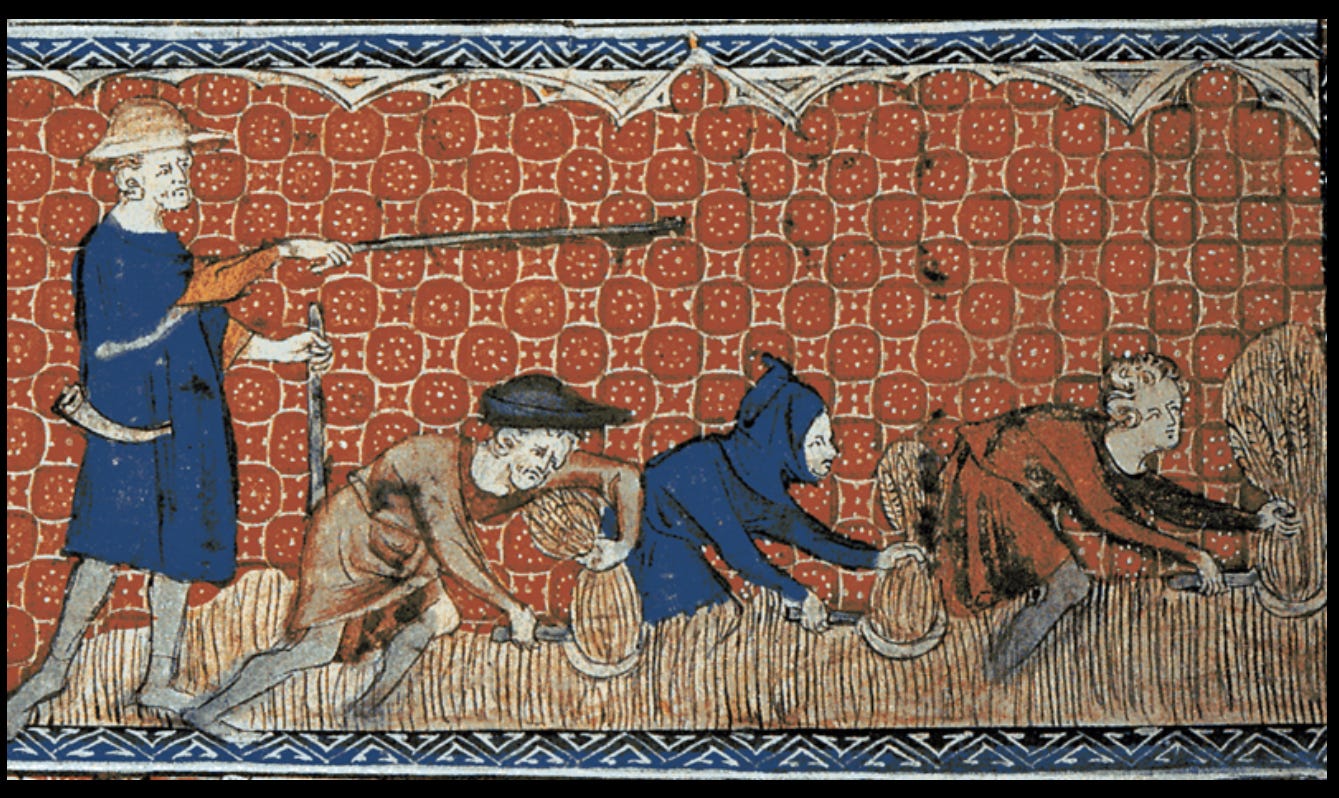
In an era when average literacy levels had dropped significantly even in the Eastern Roman Empire1, serfs – by necessity and design – were illiterate and, most often than not, poor. They were oppressed as a matter of fact, and lived shorter lives, with no Roman-era baths and entertainments. They became even more superstitious than in Roman times, and an almost immediate renewal of folk beliefs in evil spirits and bewitching was soon evident all across Europe and lands still under the control of the Constantinople emperors.
The Life of the Lycian Nicholas of Sion (d. 564) describes a local monastic founder who was used as a demon-buster by neighboring villages. And the later Life of Theodore of Sikeon (d. 613) depicts a rural world around Anatolia’s Ancyra/Ankara dominated by evil spirits, possessions and Christian healers; after his death, Theodore’s bones were taken to Constantinople to add divine protection to the city.
In distant Spain, the Visigoths issued laws against the tempestarii, people who claimed to be able to conjure up storms which would ruin the crops, unless paid by the peasants. It was decreed that a storm-maker should get 200 lashes, have his head shorn and be paraded through the villages of the locality in this condition2. In 8th century Bavaria, fines were stipulated against these tempestarii, varieties of which existed across the world, being further evidence of the climate disruptions typical of the period.
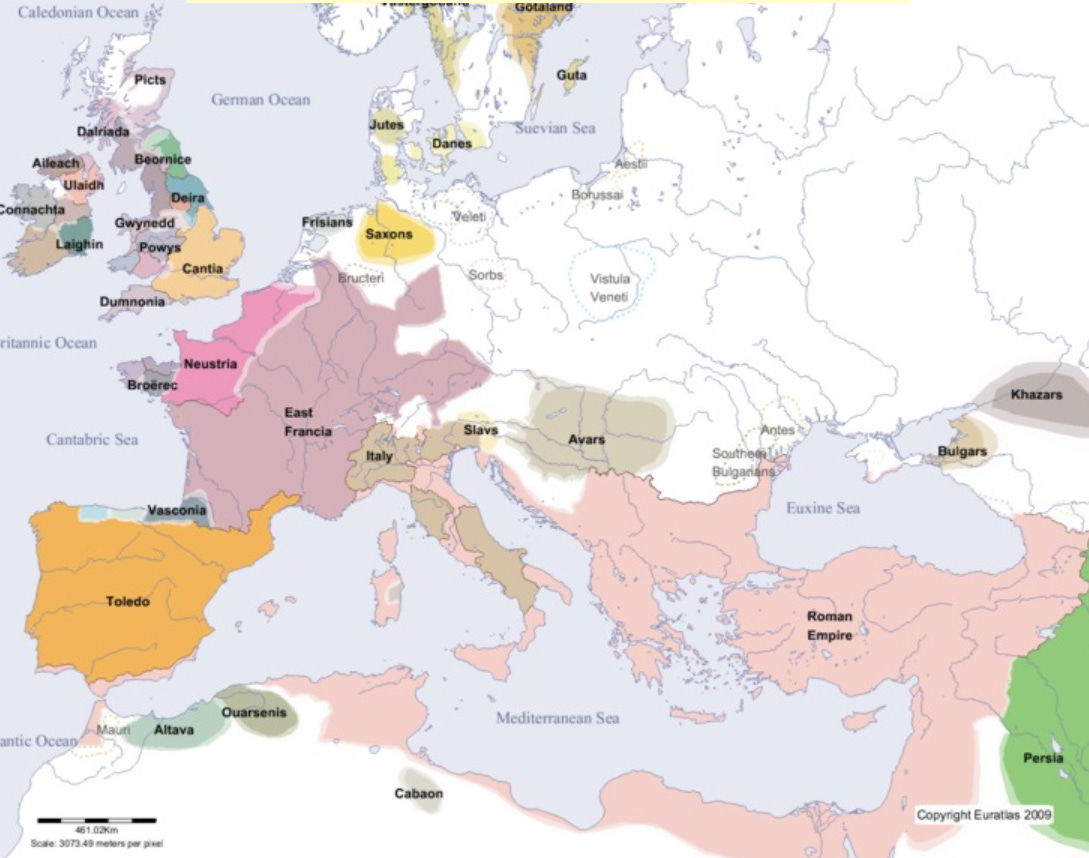
The actual standard of life of these serfs, almost all descendants from Roman-era citizens of the lands they inhabited (save for those in modern central and eastern Germany, lands who had never been a permanent part of the Roman Empire) varied significantly in each territory. It’s still fair to say that they were all were legally discriminated against by their new (or old, in Germany) barbarian overlords – who also looked down on the much smaller, but still highly significant, upper class Roman population living in the shrinking cities and holding on to some of best real estate in their countries.
For example, the Burgundian kingdom in modern Burgundy, before it was swallowed by the Franks, was ruled by a so-called Lex Burgundionum compiled under the reign of the Romanized Gundobad, one that established a legal separation between Romans and ethnic Burgundians, their conquerors, similar to that established in Hispania between Visigoths and Hispano-Romans3.
Even more importantly, the legal code recovered ancient customary law precepts long discarded by Roman law, including the Germanic “wergeld” or “blood-money” payments for violent deaths and – to the great concern of Church figures like the later Spanish Bishop Agobard of Lyons (779-840) – the custom of trial by battle that would be a proud identifier of European aristocracy for over a millennium to come.
Blood-money payments (and duels) had only been a feature of Graeco-Roman legal systems in the distant past. For example, by the mid-2nd century, the famous jurist Gaius wrote that arsonists were to be bound, flogged and burnt alive, but those who could prove they had caused fires by mere negligence could be simply forced to pay compensation4.
Such payments were an exception in Graeco-Roman legal codes that generally empowered society as a whole (represented by the legal established government) to punish wrongdoers, not letting them get away by paying off their victims or their families; they were particularly humiliating in that, typically (for example, in the Franks’ Salic Law), they established much higher wergeld if the victim was not Roman than otherwise.
The same happens with bride kidnappings: an archaic practice long left behind by the Greeks and the Romans who had, supposedly, once resorted to the Rape of the Sabines, it was reintroduced in barbarian law codes, so that Aethelbert’s code in early 7th century Britain includes detailed compensation payments to the bride’s family, differing when the woman had been returned or kept as legal — rather than, shall we say, temporary — wife5.
In the larger part of Britain soon be known as “England” after the most numerous of the barbarian invaders, the separation between the old inhabitants of the land and the new warlord settlers was particularly radical. Arriving in a land where – much as in Berber North Africa and Egypt – Latin was widely known but older languages (Celtic in Britain) were still in everyday use, the Anglo, Saxon and Jute invaders only adopted around thirty words from Celtic into their evolving, Germanic Old English language.

Southern and eastern Britain filled with new pagan temples where Germanic gods were worshipped, and these worshippers left behind place-names like Harrow in Middlesex and Harrowdown in Essey, deriving from the word “hearh” (idol or temple); weoh (Weedon in Buckinghamshire, Weoley in Worcestershire) seems to refer to a holy site; Woden left its imprint in Woden’s Dyke (Wansdyke)6.
Even as Celtic and Latin languages were gradually erased from existence wherever the barbarians took control – which would suggest a degree of cultural merger – the genetic evidence suggests that the rulers and the ruled lived in social isolation for decades and even centuries, with most amalgamation conducted via marriages or couplings, consented or otherwise, between local women and barbarian men7. This was particularly common in England although, in fact, the taking of Christian captives for sexual use was so common that Christian bishops across Roman and formerly Roman lands had created “postliminium,” the automatic dissolution of marriage bonds when Christians were captured8.
On the other hand, many non-sexual interactions involved enslavement, murder or/and theft. The last city standing in Britain, Verulamium near modern St. Albans, collapsed around 450. The 6th century chronicler Gildas (d. 570), in his “De excidio et Conquestu Britannie,” describes horrific destruction across the land, with towns left choked with ruins, squares filled with the foundation-stones of high walls and towers torn from their bases, as well as “holy altars, fragments of corpses, covered(as it were) with a purple crust of congealed blood, looked as though they had been mixed up in some dreadful wine-press.”9
