
Quick Take: "No Taxation Without Representation," the Myth that Triggered the American Revolutionary War
Catchy slogan, zero content: welcome to the world of 1776 propaganda

(This is the first in a series of posts commemorating the 250 anniversary of the US Declaration of Independence.)
The North American colonies were England’s plan B, at best. Plan A was, of course, France, but the French elites (and a certain teenage girl) resisted for over three centuries all English attempts at building an European super-power across both sides of the Channel. So England got stuck with, sigh, America.
On top of this, the American colonies were from the beginning a dumping ground for religious dissenters, which is evident even in their name: “colonies,” very unlike the more polite “overseas provinces” that Spain preferred for its own equivalents. Such dissenters left their mark on the land, and it was one that well-bred Englishmen hated.
In fact, both the Plymouth and Massachusetts colonies were so quick to expel those with unpopular opinions that this resulted in the creation of one additional colony – Rhode island – when Roger Williams was kicked out of those because of his dissenting views.
Bigotry was the dominant mode of behavior among the early settlers of the northernmost colonies, so much so that their descendants later spent centuries trying to shift the meaning of the word until, by the 21st century, they managed to turn it into a tame, unnecessary synonym for “racism,” the better to cover their tracks. The fact that the colonies were isolated from any significant emigration flows after religious persecution ceased in England in about 1640 only reinforced their insularity.
The two million white colonists of 1776 were largely the descendants of the few tens of thousands who had moved to the eastern coast of North America in the very first wave of colonization: some 20,000 in New England, almost all of them Puritans, and about 60,000 on all the other English colonies – a situation very much unlike the slow drip of peninsular arrivals seen by the American territories under Spanish control, and even the Caribbean lands under control of other European nations, dominated by two-way traffic from their metropolis.
The English colonies also had a remarkably high degree of control over their own business. The English government, only too glad to be rid of rebellious Puritans, Quakers and Roman Catholics, willingly gave them liberal charters often amounting to self-rule: Connecticut in 1662 secured from Charles II a charter which made the colony almost independent, of a kind no English colony ever again obtained; like Rhode Island, Connecticut elected its own legislature and governor, and did not even have to send its laws to England for approval.
The Puritan hotbed of Massachusetts was in the sense, as in others, ahead of the pack. Its own charter, from 1629, provided for a similar degree of self-rule and a recognized status for a form of religion – sometimes called Congregationalism – that was otherwise not recognized by the laws of England.
The colony very early on dropped the English oath of allegiance and adopted a new oath in which public officers and the people swore allegiance, not to England, but to Massachusetts. In addition, although the charter didn’t give Massachusetts the right to coin its own money, the colony still went ahead and did it, from 1652.
This led to mounting tension with the Crown, leading to the charter’s annulment in 1685, and its replacement with a new one that gave England the right to appoint the governor. Even after a revolt and a petition by the colonists, the 1691 charter – merging Massachusetts and Plymouth – still kept the appointment of governors as a royal prerogative.
Further south, so-called “Cavaliers” created a different, indeed, opposite headache for the English crown. Whereas the Puritans were an outgrowth of the movement that led to the execution of Charles II, the Cavaliers were more intent on reproducing the sort of class arrangement they had left behind back home, in the typical manner of Spanish settlers. Fanning out from the Chesapeake Bay, the descendants of the Cavaliers populated the southern lowlands, bringing to them their violent, honor-obsessed ways, their love of gambling and their Cavalier attitude to religious propriety.
To this mix we must add experimentation, also an important factor in the early history of the North American English. An example of this is the Fundamental Constitutions of Carolina (1669), co-written by the later illustrious John Locke, then secretary to the Lords Proprietors of the colony.
This is the weirdest constitution ever written and a testament to the pitfalls of proposing political arrangements with no knowledge of facts on the ground. The constitution appeared in print under Locke’s name in 1720, and by 1751 was included in his collected works. It stands as an ironic caveat to Locke’s later reputation as forefather of a non-feudal US, since it envisages Carolina precisely as a feudal colony. Between the Lords Proprietors at the top and enslaved blacks at the bottom, he proclaimed, there should be two further orders of hereditary nobility, followed by free landholders and a class of hereditary serfs called “leet men.” Religious toleration was extended to all but atheists, who were barred from landholding1.
The colonies weren’t genteel. Just like piracy had been a perfectly honorable occupation in England just a few decades earlier, the armed theft of foreign ships was for long a common occupation, almost openly, across many American ports. Stamped protections – that is, letters of marque that could be presented upon capture, turning the “pirate” (liable to be hanged on the spot) into a “privateer” (a licensed master of a private man-of-war fighting the enemies of His Majesty) – were openly sold in New York, where the famous Scottish privateer William Kidd (1645-1701) secured his own papers, valid until the local governor changed his mind and sent him to London to be tried and hanged for piracy.
Friction with England was often instigated by the colonists themselves, who were unwilling to depend excessively on the motherland. When the king tried to impose duties on Virginia’s tobacco, the colonies’ main export product, the production was derived to Holland instead. This development in 1651 led Oliver Cromwell, sympathetic as he was to the colonists’ religious concerns, to ban all foreign ships from trading with the colonies – a ban reiterated in 1660 after the English monarchy was restored2 and in 1816, when an independent United States enacted a similar law to favor American shipping.
Seeking to curb rampant smuggling the colonies, the English started issuing “writs of assistance,” empowering officers to search generally for smuggled goods, without specifying under oath a particular house or particular goods3: and it’s against such writs that the early separatist James Otis (1725-1783) delivered in 1761 an oft-quoted argument before the Massachusetts Superior Court, calling them “the worst instrument of arbitrary power, the most destructive of English liberty and the fundamental principles of law.”
This sounded nice. But Otis was far from the only colonist fond of high-falutin pronouncements.
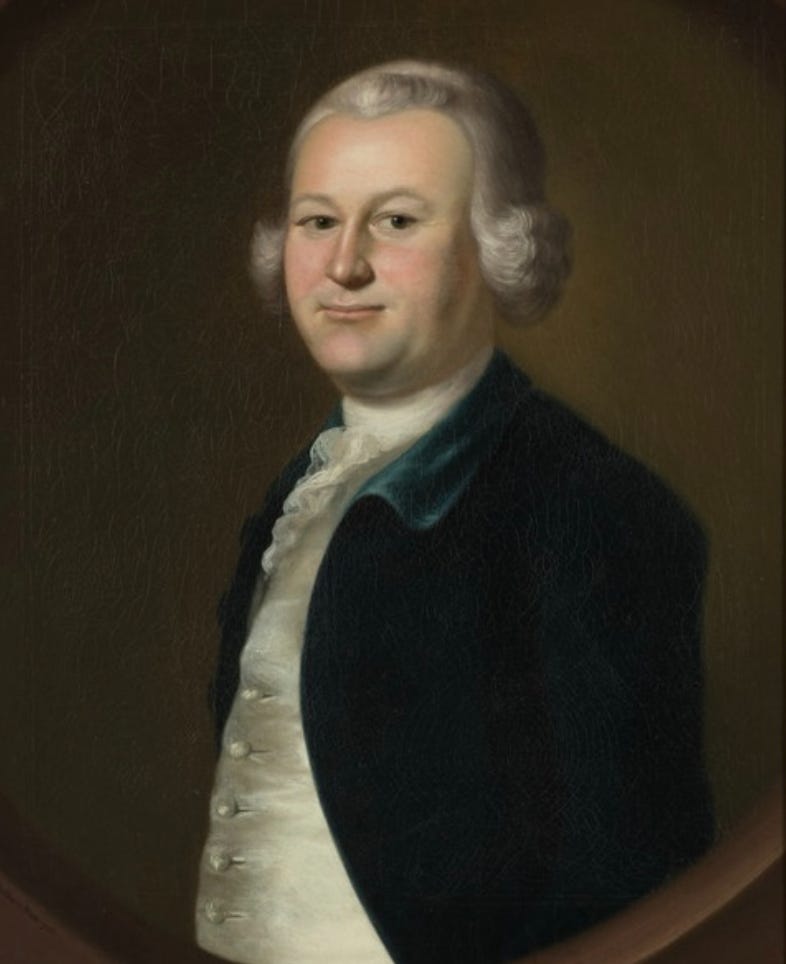
The colonial elite was well-red. Books about the rights of man and self-government written by Cesare Beccaria, Montesquieu, Grotius, Locke and some guy called Samuel Von Puffendorf — who sounds like the Matthew Yglesias of his generation — circulated openly. Beccaria’s foundational doctrine, that “every act of authority of one man over another for which there is not absolute necessity is tyrannical,” made a most profound impression in the colonies. A translation of “The Principles of Natural and Political Law” by the Genevan popularizer Jean-Jacques Burlamaqui (1694-1748)…

… was among the first books owned by the first library of Philadelphia, and a well-worn copy read by delegates to the Continental Congresses was still available for borrowing in the early 20th century4.
In this context, the Stamp Act of March 1765 emerged as a the perfect trigger to bring the American elite together in near-universal rejection of English impositions: the Act required that all printed materials – including legal documents, newspapers, playing cards and even dice – be produced on stamped paper purchased from Britain, taxed on arrival, bearing an official revenue stamp; this presented a cause that was simple to explain and disliked by all, high and low, since even craftsmen and farmers played cards.
Virginia led the way in passing resolutions against the Stamp Act, and it was in speaking on these resolutions that the silver-tongue planter Patrick Henry (1736-1799) made his famous speech, stating that “Caesar had his Brutus, Charles I his Cromwell, and George III may profit by their example” – enough to hang him pretty much anywhere else on the planet5. Since the English took that on the chin, an incendiary speech by a Puritan reverend followed and the house of Massachusetts then-Lieutenant-Governor Thomas Hutchinson (1711-1780), a Boston-born loyalist, was destroyed by a mob. Hutchinson himself had to flee for his life.
In the Stamp Act Congress of October 1765, delegates from nine colonies met in New York, issuing the Declaration of Rights and Grievances against taxation without consent. The slogan “no taxation without representation,” later much quoted, gained popularity among the colonists during this particular crisis – even though the colonial elite never sought representation in the English parliament, given the logistical difficulties, and when it was half-heartedly offered the elite rejected it, much preferring the propaganda effect to be gained by displaying the injury to the obvious cure.
This contradiction was happily espoused by the separatists, and Whig Prime Minister George Grenville (1712-1770) noted it in a speech in parliament. Francis Bernard (1712-1779), then Massachusetts governor, remarked upon the fact in his letters. As Sydney George Fisher writes (Op. Cit., p. 60), summarizing Bernard’s letters:
“At first the colonists were willing to be represented in Parliament, and made their argument in the alternative that if they were to be taxed internally they must be represented; but fearing that representation might be allowed them, and that they would be irretrievably bound by any measure passed by Parliament, they quickly shifted to the position that representation was impossible, and therefore internal taxation constitutionally impossible… The documents of the colonists do not express a willingness to be represented, although there are expressions used from which such a willingness might possibly be inferred. They may, however, have expressed such willingness in conversation; but after the time of the Stamp Act Congress all their published statements cling tightly to the impossibility of representation.”
Massachusetts’ own assembly circulated a letter to all other colonial assemblies in 1768, asserting that it is impossible that the colonies should ever be represented in parliament (it also declared in all seriousness that the colonists were not seeking “ to make themselves independent of the mother country,” so this might be taken with a grain of salt.)
It must be noted that, while Wales and Scotland had MPs in the British Parliament at this time, Ireland did not, since it had its own parliament, with very limited powers. Sea travel to England, even from such a close place as Ireland, was more of an impediment that it might appear to us Ryanair aficionados.
Loyalists on both sides of the pond could hardly push the point, however, since they understood the demographic consequences of insisting upon American representation in parliament. At the time, the Twelve Colonies had 2.1 million people, including about 460,000 slaves, and this population was exploding even without immigration; meanwhile, immigration, especially from Germany, was proving to be an ever-expanding stream. In 1776, the population had grown to around 2.5 million – compared with 6.5 million at the English imperial core – and was at 2.7 million in 1780.
Among this very young population, support for the separatist cause was rather strong, always estimated at close to half of adult white males, with just around 20% considered loyalists willing to support the Unionist cause, and the rest uninterested in picking a side6. And, even if the loyalists were to change the political tides, they couldn’t change the demographic ones: it was a matter of time before the colonies would surpass the motherland in population, which would entail that, with parliamentary representation, they would accrue political dominance and the imperial center would shift from London to whichever city the Americans would pick as their capital, a development that in the end was delayed until 1945.
At this key juncture, Ben Franklin – the one man beloved on both sides of the pond – spoke in Parliament against the Stamp Tax and a Whig cabinet, sympathetic to the colonial elites and concerned about boycotts, withdrew the planned tax. In the process, it compounded the damage: the English had been shown to be tyrannical, and also weak tyrants who could be easily compelled to stand down. Moreover, they garlanded their retreat with the purely rhetorical Declaratory Act, asserting that Parliament had “full power and authority to make laws and statutes of sufficient force and validity to bind the colonies and people of America ... in all cases whatsoever” – the unnecessary equivalent of an ignored boss giving his rebellious subordinate a piece of paper stating the facts of their theoretical relationship.
Elated separatists gave their rhetoric another turn of the screw. The Virginian planter Richard Bland (1710-1776), a cousin and mentor of the much younger Thomas Jefferson (1743-1826), published in 1766 an influential pamphlet, “An Inquiry into the Rights of the British Colonies,” in which he rehashed typical French arguments against absolute monarchy, replacing references to little-known or fictitious, primitive Gallic or Frankish assemblies with Anglo-Saxon equivalents.
Bland’s central argument that the ancestors of the English – like those of the French cited in France – maintained their rights, which they only ceded as part of a deal with the king that the king was also bound to honor, proved extremely popular, being a neat fit with those of the famous Locke, frequently cited on the strength of his ideas about contract and consent7. It also was a fundamentally correct argument, in that Indo-European monarchs, from ancient through Hellenistic Greece, Rome and across the Middle Ages, had always recognized customary limits to their power and the right of freemen representation: and so it was another argument that couldn’t be easily attacked by honest loyalists without attacking the very basis of Britain’s parliamentary regime.
The spiral of offenses and responses over the following decade was convoluted and to a large degree is evidence of a colonial elite desperately in need of any excuse to rise against overseas masters it saw as detrimental to the growth of their own domain. The Stamp Act itself was hardly outrageous, and the colonists themselves struggled to make sense of why a scheme that never went into effect, seeking to make colonists pay for an embossed stamp on their official documents, was reason enough for war; much the same happened with the related tea tax, which lowered the price of tea, inconveniencing mostly colonial middlemen.
The fact that England between 1766 and 1768 was again led by PM William Pitt, by then an aging Whig with a broken health and a shattered nervous system, presented an additional opportunity for the separatists. He was afflicted with paroxysms of anger, could not bear the slightest noise and – most remarkably – required a constant succession of chickens to be kept cooking in his kitchens all day to satisfy his unreliable, but at times ravenous, appetite8.
Pitt wasn’t a formidable enemy to contend with, and indeed he was rather sympathetic to the colonists’ position9; rather than aggravating them with another attempt at internal taxation, he supported the Townshend Acts of 1767 imposing external, import duties on glass, lead, paints, paper and tea shipped from Britain to the colonies. The plan was to use the revenue raised to set up a colonial civil list providing fixed salaries to colonial officials, so that assemblies wouldn’t be able to blackmail them by withholding and cutting back their salaries.
The colonists saw through the attempt and boycotted such imported products with a degree of success. The Boston Gazette on Sep. 20, 1768, openly published the threat that the colonists might appeal to France, another rather treasonous action that the British preferred to ignore. Such loud protestations weakened Pitt’s government and drove the Pennsylvanian Quaker John Dickinson (1732-1808), one of the wealthiest planters, to write a series of misleadingly titled “Letters from a Farmer” arguing that the British parliament didn’t have any authority whatsoever to raise revenue from the colonies. That this shocking argument came from a man widely seen (at the time and later) as one of the most moderate Patriots reveals much about the state of mind of the others.
After his resignation, Pitt was succeeded until 1770 by the thirty-three-year-old Duke of Grafton, a political amateur; the Tory Frederick North (1732-1792), prime minister for the next twelve years, finally repealed parts of the Townshend Acts, in another gesture that sought sympathy and found contempt. During this period, Boston’s Samuel Adams became the driving force for anti-English agitation, through his clandestine Sons of Liberty organization, specialized in mob tactics and physical intimidation of loyalists. Adams also put his weight behind what was effectively a news service, called the Journal of Occurrences, composed in Boston but intended to be circulated, and reprinted, elsewhere in the colonies.
Mercy Otis Warren, a sister of James Otis and member of a prominent pro-independence family, in 1772 set up a dramatic performance of her play “The Adulateur,” with the bad guy obviously a thinly fictionalized version of the hated Thomas Hutchinson, governor of Massachusetts from the previous year – the first of a series of dramatic sketches shaping a novel approach to satire that electrified the emerging revolutionary movement10.
Trans-Atlantic agitators fueled the fire with tracts like Thomas Paine’s “Common Sense” – perhaps the most popular pamphlet in history. It is not common, and contains little sense, as it focused on an abstract account of the difference between a positive “society” and a negative “government” arbitrarily imposed from above by a distant colonial master – although not so distant for Paine himself, a radical Whig who had arrived in America, from London, only in 1774 to wage what effectively was a British civil war; or for the resolutely London-based libertine essayist John Wilkes (1725-1797), extremely popular in the colonies.
In that same year of 1774, colonial opinion was again agitated when parliament passed the Quebec Act under which French Canadian Roman Catholics were granted emancipation and Roman Catholicism was adopted as the state church of the now British Province of Quebec. This was a defensive measure seeking to ensure that the Canadians wouldn’t join the separatist tide, and the backlash was fierce: widespread indignation among righteous American protestants found its greatest expression in what may be the flashiest flag ever designed in the continent: the protest George Rex Flag, an altered Blue Ensign with the added legend “George III Rex and the Defender of the Liberties of America. No Popery.“
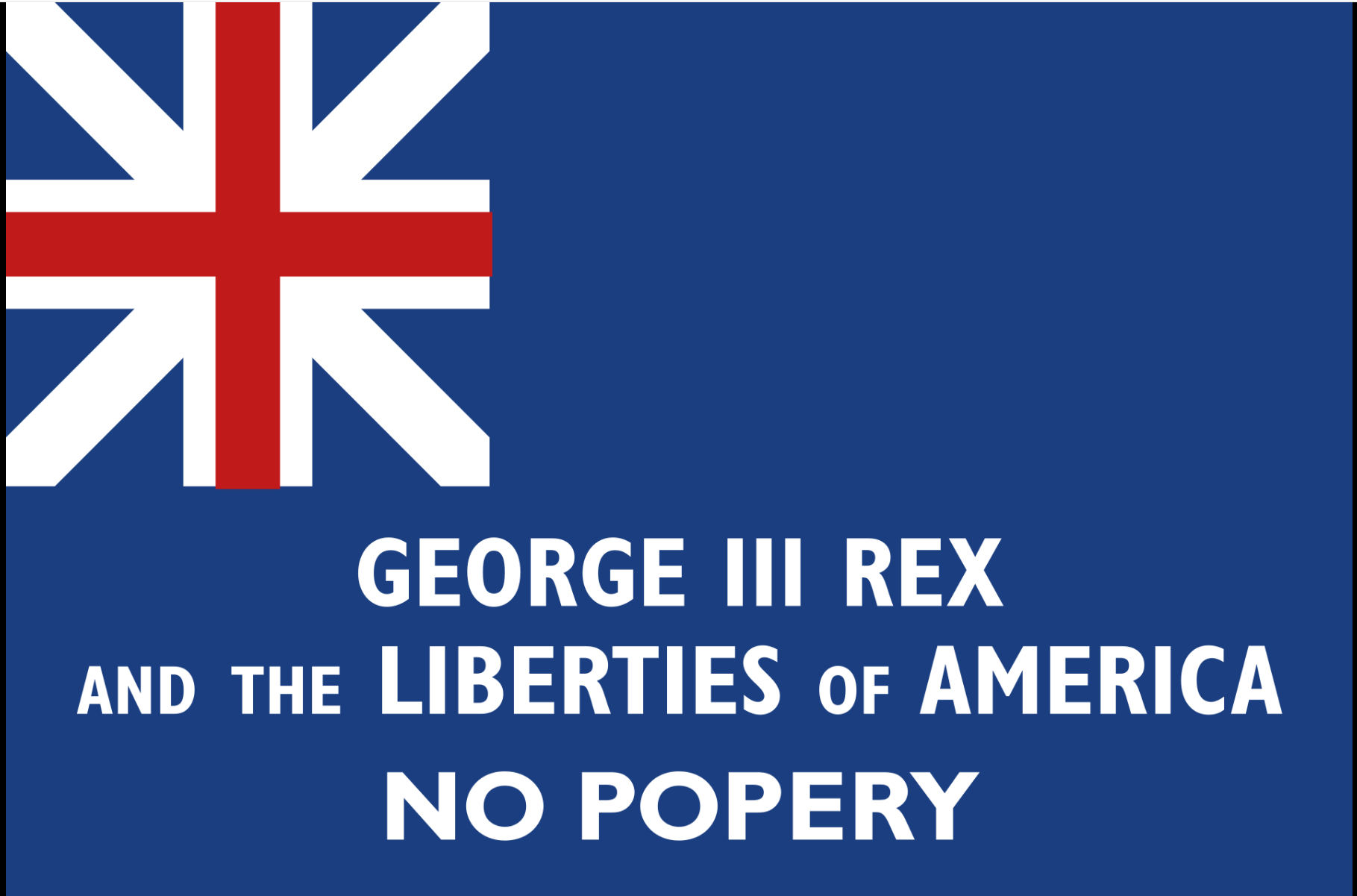
Remarkably, New York patriots often viewed the monarchy as a symbol of unification and opposition to what they saw as a hostile parliament, until separatists coalesced around the argument that the King had violated his oath by allowing Catholicism in Quebec to flourish. The flag was still, confusingly, used by the rebels until the Grand Union Flag was adopted in 1777.
In any case, the Quebec Act – all in all, the result of English concern that the French-speaking population of their four northernmost colonies, a majority, would seek to determine their own destiny – was included in the five Intolerable Acts which outraged Patriot opinion that year, and led to the formation of the First Continental Congress: so curiously named because the separatists were still wary of calling the meeting a “National Congress.”
By this time, the breach between the colonial elites and the metropolis was so broad that any narrowing would have made little difference. A small duty on tea, kept in place by Lord North, had no impact whatever because the colonists kept smuggling their tea from the Netherlands. Meanwhile, a vacillating policy in London, where various governments were never quite sure of how far they should go in tightening control over the colonies, fueled a growing American consensus that the colonies’ interest, focused as it was on geographical expansion and unfettered trade, was incompatible with England’s priorities.
War was the only option left. But the war to follow — an internecine Whig conflict by proxy, for the most part — would be one of the most confusing in history, as the enemy for a long time couldn’t quite bring itself to fight a series of ideas that were as appreciated in London and Paris as they were in Philadelphia.
In 1671, the Lords Proprietors rewarded Locke’s efforts in shaping the colony’s form of government by elevating him to the rank of a hereditary landgrave of Carolina, which may have been the plan all along. I mean: why not? That this alleged promoter of democracy and equality dreamed of being a superior aristocrat with his legal superiority over the plebe fortified in print is not the lesser of the ironies of this particular time.
For details on this and much more, see the rather shocking “The True History of the American Revolution,” by Sydney George Fisher (J. B. Lippincott Company, 1902). That year an additional clause was added in the navigation act that did not please the colonists. It provided that sugar, tobacco, cotton and a few other products couldn’t be carried from the colonies to any port on the continent of Europe. Such commodities should be carried only to England or to English colonies. This was offset somewhat by a 1663 act that prohibited tobacco-planting in England, an activity that had been attempted by some daring investors in defiance of the climate. This act sought to favor the Virginia and Maryland tobacco-planters.
Sydney George Fisher, Op. Cit., pp. 42-43.
Sydney George Fisher, Op. Cit., pp. 137-139.
The same Henry would utter an even more famous and dramatic phrase in 1775, when he said “Give me liberty or give me death” during a separatist convention in Virginia
Some historians and commentators have misattributed a comment by John Adams, made in a letter in 1815 to Massachusetts Senator James Lloyd, minimizing the extent of popular support for independence: “I should say that full one third were averse to the revolution…. An opposite third… gave themselves up to an enthusiastic gratitude to France. The middle third… always averse to war, were rather lukewarm both to England and France….” Adams here as not addressing America’s rebellion, but American attitudes towards the French Revolution. The mistake appears to stem from historian Sydney George Fisher, who misinterpreted Adams’s meaning in his 1908 book, “The Struggle for American Independence.” Two years prior, letter of his to old Continental Congress friend, Delaware’s Thomas McKean, Adams estimated popular support for independence at around two thirds of Americans. In his 1902 history of the revolution, Sydney George Fisher cites various contemporary estimates of support for independence: for instance, the British General Robertson, in his testimony on the conduct of the war, told parliament that the patriots were only about a third of the people, “but by their energy in seizing arms and assuming the government they kept the others in subjection.” As he explains, the loyalists themselves always believed that they were a majority: “Their upholders have supported this assertion by showing that over twenty-five thousand of them enlisted in the British army, and that, without counting those in the privateers and navy, there were in 1779 and at several other times more of them in the British army than there were soldiers in the rebel armies of the Congress.” In truth, Washington never had twenty-five thousand men under his command.
18th Century Americans knew Locke primarily as a philosopher of mind, the author of An Essay concerning Human Understanding (1689), rejecting the existence of innate principles imprinted on the mind, arguing rather that knowledge derived from sensory experience of the world around us and internal reflection. By the 1740s the Essay concerning Human Understanding was on the logic curriculum at both Harvard and Yale. The Declaration of Independence doesn’t straightforwardly reiterate Lockean arguments. Its commitment to “life, liberty and the pursuit of happiness” is a more idealistic, proto-progressive tweak on Locke’s formulation that political society was created for the ‘mutual preservation’ of its members’ “lives, liberties and estates.”
Sydney George Fisher, Op. Cit., p. 82.
Up to his death, in 1778, Pitt – Lord Chatham by that point – occasionally appeared in the House of Lords to make eloquent appeals, denouncing the Tory government because it would not withdraw all the troops from America and make a peaceful arrangement with the colonists.
Cit. “Mercy Otis Warren: Revolutionary Propagandist,” by Jonathan House, Journal of the American Revolution, 24.10.2023. Unbeknownst to most of the public, Hutchinson was a personal and political enemy of the author’s father, James Otis Sr. After independence, Warren went on to write a series of historical dramas such as The Ladies of Castile and then returned to the political fray with a 1788 pamphlet arguing against the ratification of the U.S. Constitution. Like other anti-federalists, Warren believed the new charter proposed a system of government as oppressive as the one the country had just thrown off. In 1805, Warren published the first volume of her three-volume “History of the Rise, Progress and Termination of the American Revolution.”
Why so down on Samuel Von Pufendorf (one 'f')?
Great article - thanks for sharing it!