When Everybody Was Christian
A History of Mankind (345)

Unbeknown to anyone, Christianity peaked in the Levant just as Muhammad was growing up in provincial Arabia.
By the middle of the 6th century, Sasanian-held cities like Basra, Mosul and Tikrit filled with burgeoning Christian populations. Kokhe, close to Ctesiphon, was served by no fewer than five dependent bishoprics. The monk “Aluoben,” who led a delegation of Syriac Christians who arrived in Chang’an to introduce Christianity in China in 635, was Iranian1. The “Romance of Julian,” perhaps the oldest historical novel, was probably written in the 6th century, telling the story of Julian the Apostate, Jovian and Sasanian Emperor Shapur II in Syriac –with a distinct anti-Jewish slant as Jews are presented as strongly supportive of Julian’s anti-Christian policies2.
Merv, Gundeshapur (once the second largest city in the Sasanian realm) and even Kashgar had archbishops long before Canterbury did; Syriac missionaries were so active deep in Asia that the Syriac script eventually inspired the Mongolian script. Theological debate was persistent, with a popular discussion of the era dividing scholars between Creationists, who held that God creates ever soul, and Traducians, less influential in the East than the West, who held that souls of each new person derive from those of their parents.
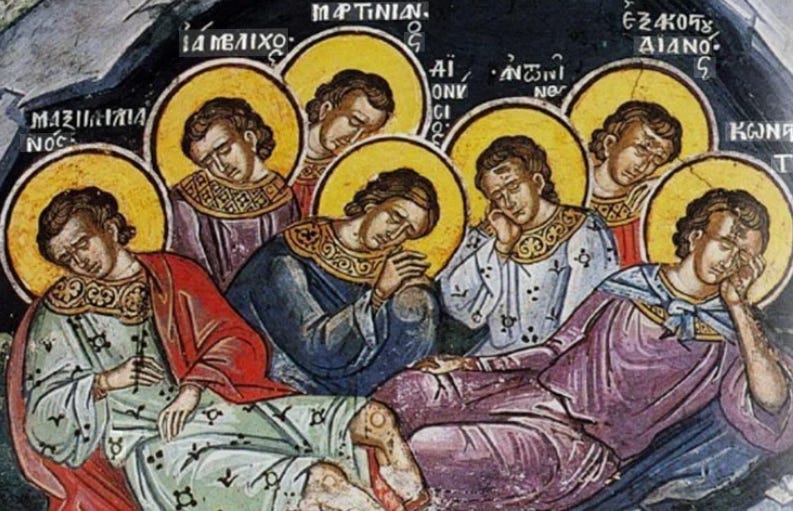
The later legend of the Seven Sleepers – popular in the Christian and Islamic traditions, and also known as the Sleepers of Ephesus and Companions of the Cave, and a clear precedent for time-travel tales – has its roots in the Grek Asian city of Ephesus. There, a group of Christian youths who hid inside a nearby cave us around 250, to escape one of the Roman persecutions, allegedly emerged in the middle of the 6th century. Unsurprisingly, the fanciful tale was translated into multiple languages, including Central Asian tongues like Persian and Turkish languages.