
Quick Take: Why the "Thucydides Trap" Needs to Be Retired
The Thucydides Trap theory doesn't explain anything

There are few theories simpler and more overrated than the Thucydides Trap.
Even though it sounds like an ancient historical law, and people who cite it often seem to think it is, the Thucydides Trap is a pretty recent US concoction. In a nutshell, it purports to describe the tendency towards war when an emerging power threatens to displace an existing great power as a regional or international hegemon.
It’s this very simplicity that has made it popular: because who would say existing powers like to be displaced, or would never do anything to protect themselves from being displaced? On the surface, it’s so basic that, if one has to dismiss it, one should dismiss it as not so much as false as banal, unnecessary. Do we need a theory to describe why I like to have good things and I don’t like it when other people take them from me?
In a recent post, the blogger Secretary of Defense Rock took a hammer to the debate and dismantled the whole idea that the concept of a Thucydides Trap adds anything to a discussion nowadays. As he explains, the whole concept was essentially coined by Harvard political scientist Graham Allison, in a 2015 essay in The Atlantic discussing US-China relations to suggest “that conflict is almost inevitable when a rising power threatens to displace an established one.” That essay was later expanded into a book, “Destined for War: Can America and China Escape Thucydides’s Trap?” including sixteen case studies, all of them about recent historical conflicts involving Western nations — and two exotics, the Ottoman Empire and Japan — summarized by the Secretary thus:
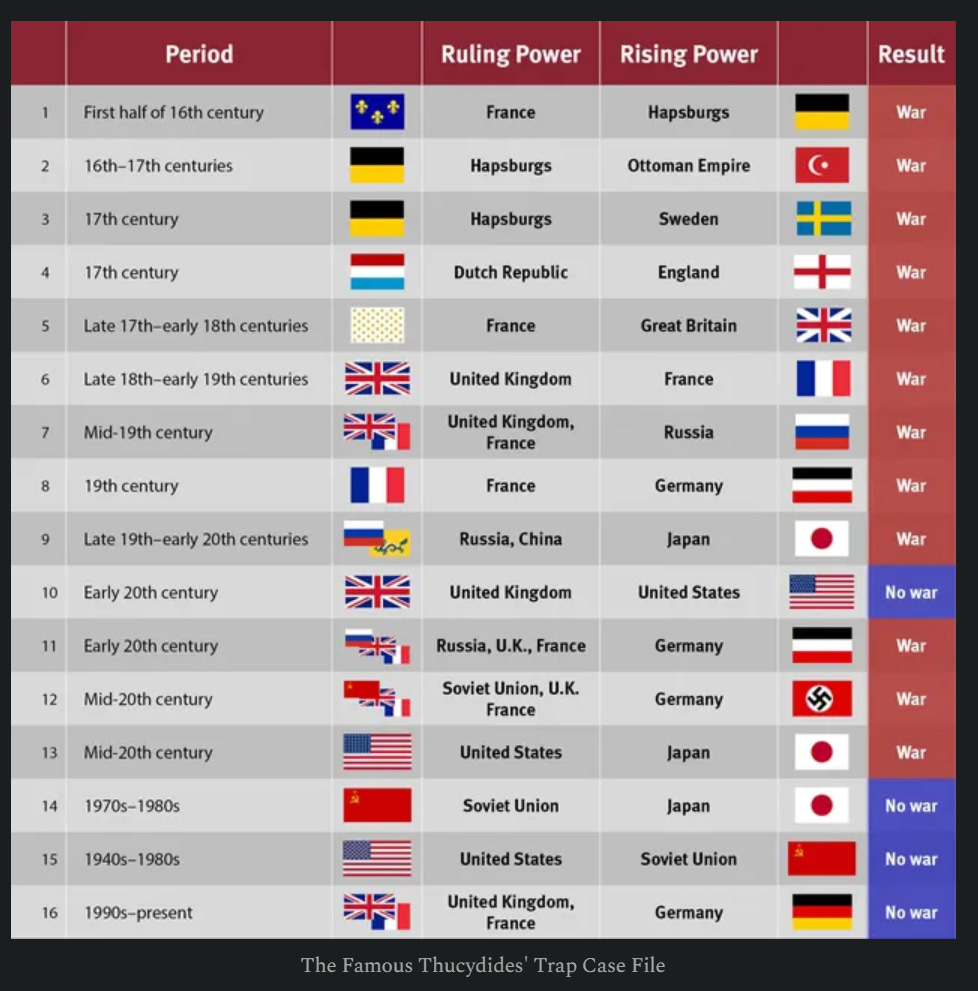
The Secretary then goes into a useful and interesting discussion of these conflicts, something which I won’t do. Instead, I’ll go back to the origin of the Thucydides Trap concept: Thucydides, and his famous quotation that triggered the whole thing to start with: “It was the rise of Athens and the fear that this instilled in Sparta that made war inevitable.”
Modern people like to quote Thucydides as a historian to be imitated, and accept his one-sided, propagandistic description of the Peloponnesian War as one that has sufficient explanatory power. Both sides of this particular equation are wrong.
It’s worth remembering that, if democracy existed in Athens, it was only because of Sparta. In the late 6th century Spartan troops “liberated” Athens from the successful tyranny of Peisistratos and their sons, at the behest of the city’s merchant classes. The merchants then resisted attempts at setting up sortition, or blind chance, arrangements to select some government positions in the knowledge that only the wealthy and powerful had resources to influence voting by the basket of Athenian deplorables.
Athenian democracy was always a solution in search of a problem. As I’ve written before, its biggest defender, the strongman Pericles (495-429 BC), was a master of vote-buying and manipulation with a gift for playing the narrow Athenian political game and very limited strategic abilities otherwise.
A tyrant under most definitions of the term, or at least an obviously precursor to Caesarism, Pericles ruled by himself, imposing his will and lording over his enemies, for thirty-two years (461 BC-429 BC), longer than Joseph Stalin or Mao Zedong, under a succession of emergency mandates. Pericles crushed subject peoples who tried to stop him from bleeding them dry with tribute and looting that he used to build the Acropolis and so many more monuments. There’s quite a lot of irony in the title of this post I wrote about the period:

Thucydides, meanwhile, was one of Pericles’ cronies. True, he was one of the smartest: Pericles was famous for being surrounded, for the most part, by fools. Most of what we know about Thucydides comes from his famous (and valuable) “History of the Peloponnesian War,” which he wrote for the last three decades of his life.
So we finally get to the Peloponnesian War. Just so we’re all on the same page, let me refresh your memory by quoting my post on “Athens’ Golden Era”:
By 449 BC, peace with the Persians was followed by widespread revolts against Athenian imperialism, crushed by Athenian troops first in Euboea, and then in Samos in 440-439 BC; there, the Athenians made use of sophisticated siege equipment unlike anything seen in the East and comparable only with the best deployed in China[9] for an important victory.
This victory prompted a sister of Cimon, a woman who remained an unrelenting enemy of Pericles, to complain bitterly that Pericles “had a lot of brave soldiers killed, not for fighting the Phoenicians or the Persians, like my brother Cimon, but to subdue a city that was our ally.”
According to Plutarch, the talk in Athens was that it was Aspasia, who came from Miletus, who pushed Pericles to attack Miletus’ old foe Samos, and that Pericles only gave way to gratify her; others have gone as far as blaming Aspasia for the later, and much more destructive, Athenian war with Sparta.
Regardless of the veracity of Aspasia-related gossip, the fact remains that Pericles’ democracy, a light of freedom for the people, was a prison for the peoples, paid for by the peoples, overseen by his street gangs and assemblies crammed with his clients and cronies. At the top was a man who found way around Athens’ rules against political mandates of over a year by having himself reappointed general annually from 443 BC to his death – in effect, becoming the first military dictator who claimed to protect democracy, and not the brightest or most efficient.
This light of freedom flickered quite notoriously too: it was at the height of Pericles’ power, in the mid-430s BC, that the so-called decree of Diopeithes (a seer) was passed to curb impiety and target those who did not acknowledge divine things and those who taught rational doctrines relating to the heavens, like the already exiled Anaxagoras.
Many would be caught in this net, particularly Pericles’ political enemies, including the tragic playwright Euripides – who was acquitted from the charges – and Euripides’ friend Socrates, who in the end wasn’t.
In 432 BC, Pericles’ blatant militarism led to the campaign and Battle of Potidaea, in which an already aging hoplite named Socrates fought with distinction against Spartan allies, next to the young aristocrat Alcibiades, who was then about eighteen. Alcibiades got an aristeia, a prize for bravery, but argued that it should have been for Socrates, who saved him while wounded — the start of a long relationship that endured long after Pericles was gone.
In a follow-up post, “The Start of Peloponnesian War,” I explain how this campaign came along:
A broader imprint of failure extended to Pericles’ legacy after he triggered the war with Sparta — with a foolish decision to involve the Athenian navy in a dispute involving Corinth, a Spartan ally, and neutral Corcyra.
This led to a tit-for-tat Corinthian intervention in the revolt of Potidaea, south of Macedon, against Athens’ Delian League.
Socrates, the philosopher, fought with distinction in 432 BC in Potidaea, a long campaign characterized by a Greek innovation that would be often used by Romans in future wars: the construction of siege walls to surround cities and strongholds. Still, the Athenians didn’t secure a victory, and indeed all they achieved was a formal declaration of war from Sparta. By 431 BC, the Spartans were invading and destroying much of Attica, with the Athenians besieged inside their city and its port of Piraeus, connected by the so-called Long Walls.
Pericles’ death in 429 BC didn’t fix the mess he had left behind. Like many others, Socrates had to fight again, at Amphipolis[1] and Delium, where more than a thousand Athenians were killed on the field, including the general Hippocrates.
So, to summarize: Thucydides claims that “it was the rise of Athens and the fear that this instilled in Sparta that made war inevitable.” But, in reality, we have a neutral party in conflict with a Spartan ally, and Athens decides to involve itself, because Pericles had been warmongering against Sparta for his entire career.
Remember Cimon, the guy cited earlier by his angry sister? He was a son of the great Miltiades, who led the Athenians to victory against the Persians while Pericles’ wealthy family sought a deal with the enemy; but Cimon wanted friendly relations with Sparta, and ruled Athens before Pericles: so Pericles had mobs trigger an uprising inside the city and then used lawfare to have Cimon ostracized in 461 BC. I described these events here:

Now, I’m asking you: what part of this strikes you as Sparta “inevitably” sliding towards war against Athens?
There’s little talk of Pericles these days because the democrats’ hero was such a bully that it’s best to contemplate his statues from afar; he’s praised in the absence of specifics, as Jorge Luis Borges used to crack about writers that critics want to curry favor with.
Thucydides, partly because of Allison’s exertions1, has on the other hand become exceedingly popular and oft-cited, being the proponent of a theory that rationalized the rudderless foreign policy of the Athenian democrats and their open hostility towards Sparta as some sort of historical law.
This is not to say that Thucydides was worthless. He wasn’t without valuable virtues: he knew men; he wasn’t afraid of testing the limits of what he could write without offending his own supporters; and, as befitted a man raised among Atheists, he also ignores godly explanations entirely. Thucydides’ “Melian Dialogue” is, in its directness, a perfect encapsulation of the sort of ruthless imperialism that Pericles practiced and Thucydides was supposed to justify. With great honesty, Thucydides paraphrases the Athenians’ arguments, as presented to the vanquished Melian leaders, thus:
“For ourselves, we shall not trouble you with specious pretenses - either of how we have a right to our empire because we overthrew the Mede [Persians], or are now attacking you because of wrong that you have done us - and make a long speech which would not be believed; and in return we hope that you, instead of thinking to influence us by saying that you did not join the Lacedaemonians [Spartans], although their colonists, or that you have done us no wrong, will aim at what is feasible, holding in view the real sentiments of us both; since you know as well as we do that right, as the world goes, is only in question between equals in power, while the strong do what they can and the weak suffer what they must.”
I’m not arguing here that Thucydides should not be read, or praised, or taken into consideration as a valuable source for his era. Or that Allison’s book has no worthy insights: in fact, I can only praise Allison for his attempts at injecting sanity to the debate about China-US relations. My point is that the Thucydides Trap thing is at best a distraction from Thucydides’ real contributions.
During the first Gulf War, visitors to the Office of General Colin Powell, later US secretary of State, could not fail to notice the Thucydides quotation which was sealed into the glass covering his desk: “Of all manifestations of power, restrain impresses men most.” Too bad that Thucydides never wrote that. The quotation is a paraphrase of the argument Thucydides puts in the mouth of the Athenian general Nicias in a speech aimed at dissuading the Athenians from invading Sicily: “The best way for us to make ourselves feared by the Hellenes is not to go there at all; and the next best thing is to make a demonstration of our power and then, after a short time, go away again. We all know that what is most admired is what is farthest off and least liable to have its reputation put to the test; and if anything went wrong with us, they would immediately look down on us and join our enemies here in attacking us.” Even earlier, Friedrich Nietzsche, whose grasp of ancient Greek stuff was shakier than he thought, did much to popularize Thucydides with pretty blatant misinterpretations.